Gospel Study Guide

The Four Gospels, Compared

Four witnesses, one Lord: what each Gospel sees, and why the church kept all four

The Four Gospels in One Paragraph

The word "Gospel" means good news. Before it was the name of a kind of book it was the name of a message, and Mark uses it that way in his very first line:

The beginning of the Good News of Jesus Christ, the Son of God.

Mark 1:1, World English Bible

Why Four Gospels?

Nobody planned it. Four accounts were written, in four places, for four groups of readers, and the churches that received them recognized all four as apostolic. By the late second century they were circulating together as a set. Irenaeus, bishop of Lyons, writing around AD 180, took the number for granted and argued from it: just as there are four zones of the world and four principal winds, he said, the church has four pillars, and the Gospels can be "neither more nor fewer" than four. He was also the first to match the four living creatures of Ezekiel and Revelation to the four evangelists, though not in the set that later became standard (Matthew the man, Mark the lion, Luke the ox, John the eagle), which is Jerome's and the one in the table below.

The church could have done otherwise. In the same century Tatian wove the four into one continuous narrative, and Syriac churches used his harmony for a long time. But the wider church kept the four separate: four witnesses, each with his own angle, rather than one tidy account. Luke's preface shows why that was never a problem. He knew of other accounts, he worked from eyewitnesses, and he wrote his own ordered narrative for a particular reader:

Since many have undertaken to set in order a narrative concerning those matters which have been fulfilled among us, even as those who from the beginning were eyewitnesses and servants of the word delivered them to us, it seemed good to me also, having traced the course of all things accurately from the first, to write to you in order, most excellent Theophilus; that you might know the certainty concerning the things in which you were instructed.

Luke 1:1 to 4, World English Bible

Four Gospels, then, is not a problem to be solved but a gift to be received. The church has read them as four portraits of one face.

What Each Gospel Emphasizes

Matthew: the King who fulfills the Scriptures

Matthew opens with a genealogy that names the two ancestors a Jewish reader needed to hear first: "The book of the genealogy of Jesus Christ, the son of David, the son of Abraham" (Matthew 1:1, WEB). It quotes the Old Testament more than any other Gospel, pausing again and again to say that the prophets have been fulfilled. It gathers Jesus' teaching into five long discourses, beginning with the Sermon on the Mount, and it alone records the Magi, the flight into Egypt and the Great Commission. Its first readers were Jewish Christians, and its portrait is of the promised King. Read the full guide to Matthew.

Mark: the Servant who acts

Mark is the shortest Gospel, sixteen chapters, and the fastest. It has no birth story and little extended teaching; it moves from one deed to the next, and its favourite word is "immediately." Papias, early in the second century, said that Mark had been Peter's interpreter and wrote down what he remembered of Peter's preaching, accurately but not in order. The book turns on Peter's confession in chapter 8, and from there it heads for the cross. Only Mark records the young man who fled from Gethsemane. Its portrait is of the Son of God who came to serve and to give his life. Read the full guide to Mark.

Luke: the Saviour of all people

Luke is the only Gospel with a sequel, the Acts of the Apostles, addressed to the same Theophilus. It begins with the birth of John the Baptist, traces Jesus' genealogy back past Abraham to Adam, and gives us the shepherds and the manger. A long central section, 9:51 to 19:27, follows Jesus on the road to Jerusalem and holds most of the teaching only Luke records, including the Good Samaritan and the Prodigal Son. Women, the poor, Samaritans, tax collectors and sinners have a place here that they have nowhere else. Its portrait is of the Saviour whose good news is for everyone. Read the full guide to Luke.

John: the Word made flesh

John begins not in Bethlehem but before creation: "In the beginning was the Word." It tells few of the Synoptic stories and many of its own: the wedding at Cana, Nicodemus, the woman at the well, the raising of Lazarus, the washing of the disciples' feet, and Thomas. It has no parables of the Synoptic kind; instead it has long dialogues and the "I am" sayings. Much of its action is in Jerusalem at the feasts rather than in Galilee. And it tells us why it was written:

Therefore Jesus did many other signs in the presence of his disciples, which are not written in this book; but these are written, that you may believe that Jesus is the Christ, the Son of God, and that believing you may have life in his name.

John 20:30 to 31, World English Bible

Its portrait is of the eternal Son, sent from the Father, who gives eternal life to those who believe. Read the full guide to John.
The Synoptic Relationship

Matthew, Mark and Luke are called the Synoptic Gospels, from a Greek word meaning "seen together." The name comes from J. J. Griesbach, who in 1776 published a synopsis printing the three in parallel columns, and the fact that they can be printed that way is the point. They tell the same story, largely in the same order, often in the same words. About ninety percent of Mark is paralleled in Matthew, and more than half of Mark is paralleled in Luke. Matthew and Luke also share a good deal of teaching material that is not in Mark at all, such as the Lord's Prayer and the Beatitudes.

Explaining that pattern is what scholars call the Synoptic problem. Who wrote first, and who used whom? Three answers matter for a reader:

  • The traditional order: Matthew first. Augustine, writing around AD 400, took the canonical order as the order of writing, with Mark following Matthew and abbreviating him. This was the standard view for most of church history, and it is why Matthew stands first in your Bible.
  • The Two-Source hypothesis: Mark first, plus "Q." Since the nineteenth century most scholars have concluded that Mark was written first and that Matthew and Luke each used Mark independently. The material Matthew and Luke share that is not in Mark is then explained by a second, lost source, usually called Q (from the German Quelle, "source"). This remains the majority view.
  • The Farrer hypothesis: Mark first, and Luke used Matthew. The main alternative agrees that Mark came first but denies that Q ever existed. Matthew used Mark, and Luke used both Mark and Matthew. Mark Goodacre's The Synoptic Problem: A Way Through the Maze is the clearest short case for it.

Which is right? The argument is technical and good scholars still disagree. For reading the Gospels it matters less than it might seem. Every view agrees that the three are closely related, that each evangelist arranged his material with purpose, and that each book should be read whole in its own right. When all three tell a story, it is always worth asking what each writer kept, left out or placed differently, and that question is open to any reader with three open Bibles and a little patience. You do not need to settle the Synoptic problem to notice that Matthew's Sermon is on a mountain and Luke's is on a plain, or to ask why.

John Apart

John shares remarkably little with the other three. The feeding of the five thousand, the walking on the water, the anointing at Bethany, the entry into Jerusalem and the passion are in all four; beyond those, John's material is largely his own. There are no parables of the Synoptic kind and no transfiguration; at the Last Supper John gives the foot-washing and the Farewell Discourse. Where the Synoptics place almost all of the ministry in Galilee and bring Jesus to Jerusalem once, at the end, John has him going up to Jerusalem repeatedly for the feasts, and mentions three Passovers, which is why the ministry is usually reckoned at about three years.

The earliest explanation is also the simplest. Clement of Alexandria, around AD 200, said that John, last of all, "conscious that the outward facts had been set forth in the Gospels," composed a "spiritual Gospel." He knew the story was already told; he wrote to show what it meant. His own closing sentence says as much, and says it with a smile:

There are also many other things which Jesus did, which if they would all be written, I suppose that even the world itself wouldn’t have room for the books that would be written.

John 21:25, World English Bible

John's strangeness, then, is not a problem for the other three. It is the reason the church needed a fourth.

Side by Side: A Comparison Table

The dates are estimates; no ancient source gives one. The authors are those named by the early church writers from the second century on, which modern scholars weigh differently. The symbols are the later standard set, not the one Irenaeus used.

MatthewMarkLukeJohn
Author by traditionMatthew the apostle, the tax collectorMark, Peter's interpreter (Papias)Luke, the physician, Paul's companionJohn the apostle, the beloved disciple
Likely dateAD 60s to 80sAD 50s to 70AD 60s to 80sAD 80s to 90s
Chapters28162421
Portrait of JesusThe King, son of David, who fulfills the ScripturesThe Son of God who serves and suffersThe Saviour of all, friend of the poor and the outsiderThe eternal Word made flesh
OpeningGenealogy from AbrahamJohn the Baptist; no birth storyThe births of John and Jesus; genealogy back to Adam"In the beginning was the Word"
First audienceJewish Christians who knew the ScripturesGentile readers, by tradition at Rome; Jewish customs explainedTheophilus and a wider Gentile readershipAny reader, "that you may believe" (20:31)
StructureNarrative alternating with five long discoursesGalilee to Peter's confession (8:29), then the road to the crossGalilee, a long journey to Jerusalem (9:51 to 19:27), JerusalemSigns and discourses (1 to 12), the last night and the passion (13 to 20), epilogue (21)
Only hereThe Magi, the flight into Egypt, Peter walking on the water, the sheep and the goats, the Great CommissionThe deaf man of Decapolis, the blind man at Bethsaida, the young man who fledThe shepherds, the Good Samaritan, the Prodigal Son, Zacchaeus, the Emmaus roadCana, Nicodemus, the woman at the well, Lazarus, the foot-washing, Thomas
SymbolThe manThe lionThe oxThe eagle

Which Gospel to Read First

There is no wrong answer, but there are better fits.

  • Mark, for a first read. Sixteen chapters, no slow stretches, and a story you can finish in an evening. If you have never read a Gospel from beginning to end, start here.
  • Luke, for the story. The fullest account, from the announcement of John's birth to the road to Emmaus, by a writer who set out to put things "in order."
  • Matthew, for the teaching. The Sermon on the Mount, the parables of the kingdom, the Olivet Discourse: Jesus' words gathered into blocks a church can learn from.
  • John, for who Jesus is. If your question is not what Jesus did but who he is, John was written to answer it, and says so.

A simple plan for a year: Mark, then Luke, then Matthew, then John. By the end you will have read the whole story four times and noticed, without anyone telling you, what each writer saw.

How to Study the Gospels Together

  1. Read each Gospel whole before you compare any of them. A Gospel is a book with a shape of its own, and the shape is lost if you only read it in pieces.
  2. Then take the Synoptics in parallel. A printed synopsis, or three open Bibles, shows what each writer kept, dropped or moved. Start with a story all three tell, such as the feeding of the five thousand, and list the differences before you explain them.
  3. Ask what each difference is for. The evangelists were authors, not copyists. When Matthew adds a fulfillment quotation, ask what he wanted his readers to see.
  4. Read John last, and on its own terms. Do not try to slot its chapters into the Synoptic order. Let it tell its own story, then ask what it adds.
  5. Keep the Old Testament open. All four Gospels assume you know it; Matthew and John especially.
  6. Read a good old commentary alongside. Ryle's Expository Thoughts covers all four Gospels in short passages written to be read aloud, a Gospel at a time.

Free study sheets. "The Four Gospels at a Glance" puts Matthew beside the other three on one page, and "The Life of Jesus: A Timeline" shows where each chapter falls in the story. Both are free on the free downloads page.

J. C. Ryle on the Gospels

John Charles Ryle (1816 to 1900) was an English parish clergyman who became the first Bishop of Liverpool in 1880. His Expository Thoughts on the Gospels covers all four Gospels in one voice. It began with Matthew in 1856, went on to Mark and Luke, and finished with John in three volumes, the last published in 1873: seventeen years on the four books. He wrote it, as his prefaces explain, for family reading: short expositions on each passage, plain enough to read aloud, each drawing out the doctrine, the warning and the comfort in the text. It has stayed in print ever since.

Because Ryle worked through all four, his readers get the comparison this page describes without being told about it. The same man, with the same convictions, reads Matthew's Sermon, Mark's hurried miracles, Luke's parables of the lost and John's "I am" sayings, and the differences come through in his comments. Our editions keep Ryle's words and his order and modernize what slows a reader now: the "thee" and "thou," the old spellings, and the Scripture references written out in full. Matthew, Mark and Luke are available now, each with its study workbook; John is in preparation. The books page says more about what changed and what did not.

Sources

  1. The four Gospels, World English Bible (public domain). Quotations checked against the WEB text.
  2. Irenaeus of Lyons, Against Heresies 3.1.1 (the four evangelists and their circumstances) and 3.11.8 (four Gospels, "neither more nor fewer"; the four zones, four winds, four pillars; the four living creatures).
  3. Papias of Hierapolis, as quoted in Eusebius, Ecclesiastical History 3.39.15 to 16, on Mark as Peter's interpreter and on Matthew.
  4. Clement of Alexandria, as quoted in Eusebius, Ecclesiastical History 6.14.5 to 7, on the order of the Gospels and John's "spiritual Gospel."
  5. Augustine, De consensu evangelistarum (The Harmony of the Gospels) 1.2, on the order Matthew, Mark, Luke, John.
  6. Jerome, preface to his Commentary on Matthew, on the four living creatures as Matthew the man, Mark the lion, Luke the ox, John the eagle.
  7. Eusebius, Ecclesiastical History 4.29.6, on Tatian's harmony of the four Gospels (the Diatessaron).
  8. D. A. Carson and Douglas J. Moo, An Introduction to the New Testament, 2nd ed. (Grand Rapids: Zondervan, 2005), chapters 2 and 3 on the Synoptic Gospels and the Synoptic problem, and chapters 4 to 7 on the authorship, date and audience of each Gospel.
  9. Mark Goodacre, The Synoptic Problem: A Way Through the Maze (London: T&T Clark, 2001), on the Two-Source and Farrer hypotheses and on Griesbach's 1776 synopsis.
  10. Richard Bauckham, Jesus and the Eyewitnesses: The Gospels as Eyewitness Testimony, 2nd ed. (Grand Rapids: Eerdmans, 2017), on the Papias tradition and the Gospels as testimony.
  11. J. C. Ryle, Expository Thoughts on the Gospels: St. Matthew (1856), St. Mark (1857), St. Luke (1858 to 1859), St. John (1865 to 1873), prefaces.

Frequently Asked Questions

Study the Gospels with J. C. Ryle

Ryle's Expository Thoughts on Matthew, Mark and Luke, modernized and annotated, with the study workbook for each. John is in preparation.

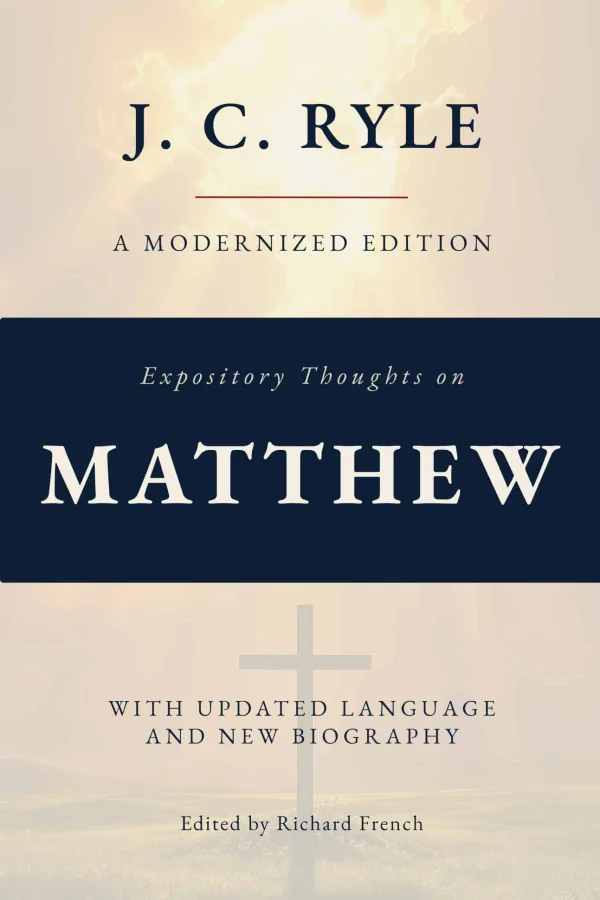
Expository Thoughts on the Gospel of Matthew (Annotated), book cover

Commentary

Expository Thoughts on the Gospel of Matthew (Annotated)

J. C. Ryle, edited by Richard French

Ryle's complete commentary on Matthew, modernized for today's reader. Short expositions on every passage, with his doctrine, warning and comfort in his own order, a new biography, and editor's notes where a word or reference needs help.

Ebook $0.99 · Paperback $21.99

Also on Amazon: paperback · Kindle

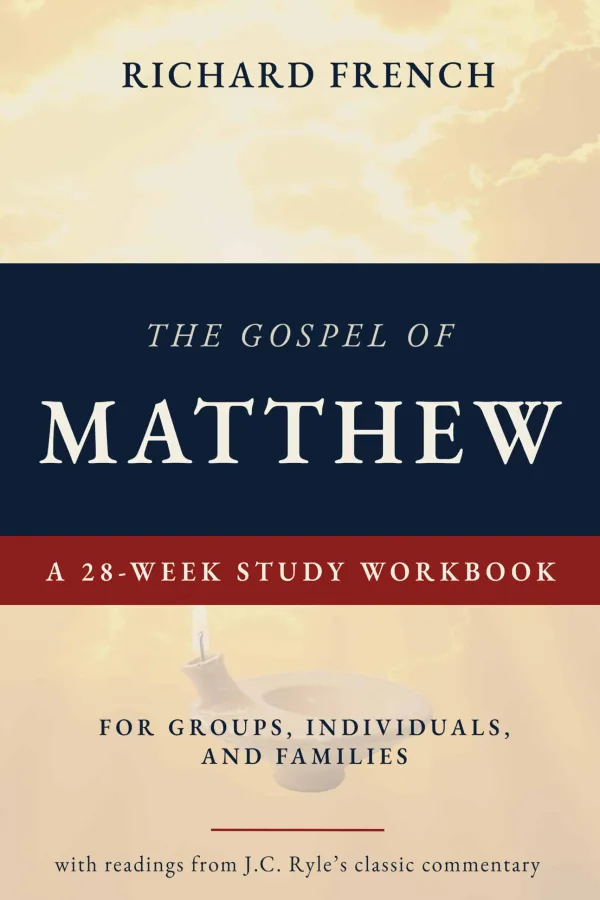
The Gospel of Matthew: A 28-Week Study Workbook, book cover

Study workbook

The Gospel of Matthew: A 28-Week Study Workbook

Richard French

One chapter a week through Matthew, with Ryle's exposition printed in each week, observation and discussion questions, the Family Fifteen for households, and room to write. Tracks for 28, 13 or 8 weeks.

Ebook $6.99 · Paperback $21.99 · Spiral-bound $24.99

Also on Amazon: paperback · Kindle

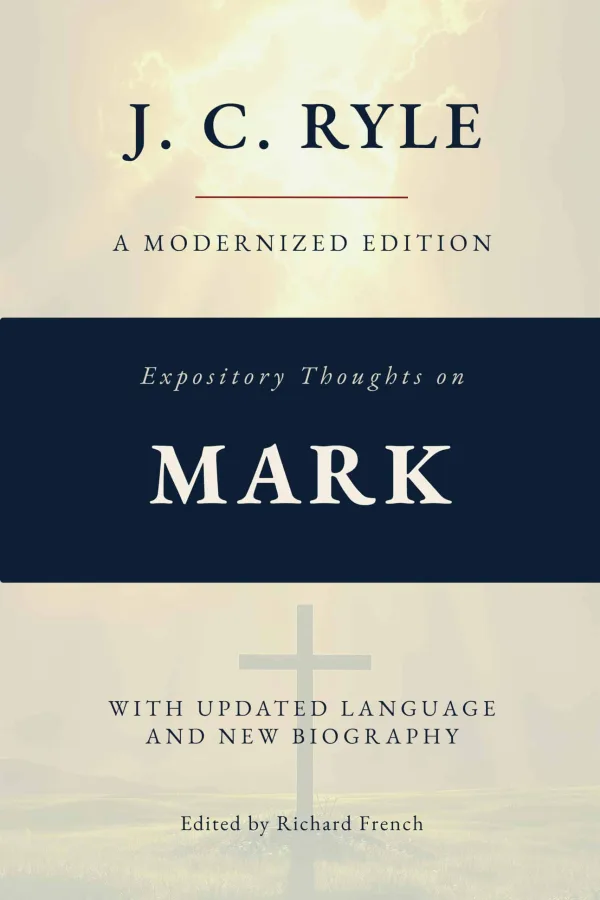
Expository Thoughts on the Gospel of Mark (Annotated), book cover

Commentary

Expository Thoughts on the Gospel of Mark (Annotated)

J. C. Ryle, edited by Richard French

Ryle's commentary on the shortest Gospel, modernized. Every passage of Mark expounded in order, with a new biography and editor's notes.

Ebook $0.99 · Paperback $21.99

Also on Amazon: paperback · Kindle

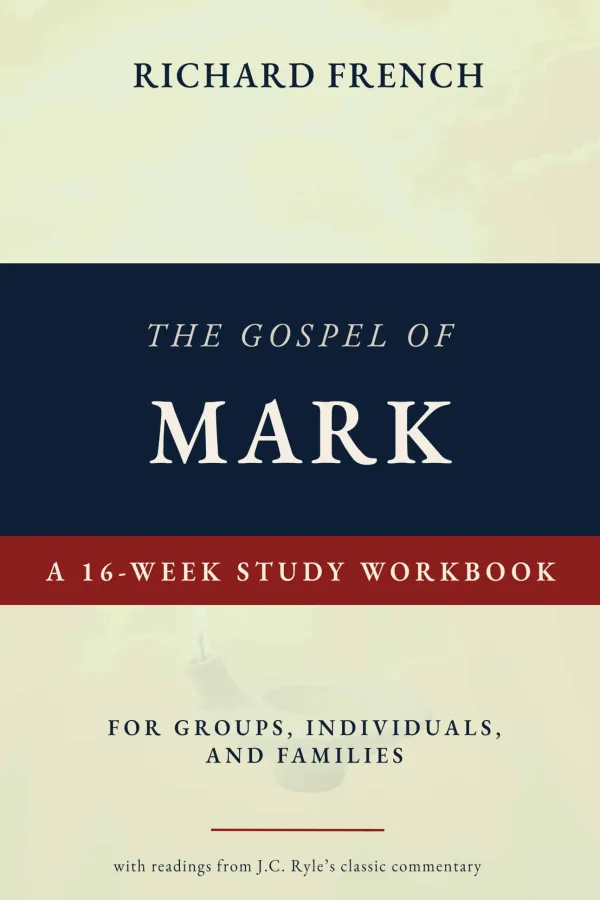
The Gospel of Mark: A 16-Week Study Workbook, book cover

Study workbook

The Gospel of Mark: A 16-Week Study Workbook

Richard French

Sixteen weeks through Mark, one chapter a week, with Ryle's exposition in each week, questions for groups, the Family Fifteen, and room to write. Tracks for 16, 8 or 6 weeks.

Ebook $6.99 · Paperback $19.99 · Spiral-bound $21.99

Also on Amazon: paperback · Kindle

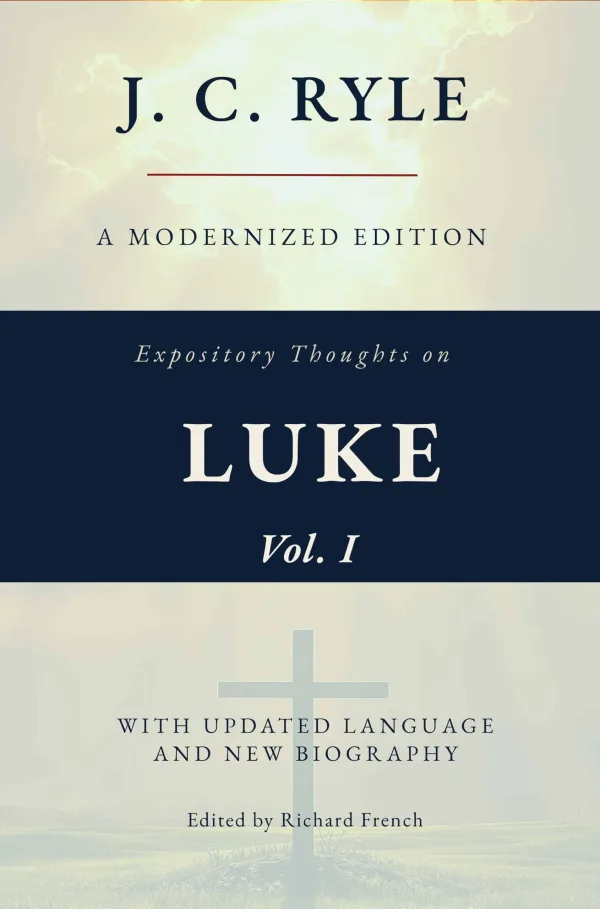
Expository Thoughts on the Gospel of Luke, Vol. I (Annotated), book cover

Commentary

Expository Thoughts on the Gospel of Luke, Vol. I (Annotated)

J. C. Ryle, edited by Richard French

Ryle on Luke 1 to 10, modernized. The birth narratives, the start of the ministry in Galilee, and the sending of the seventy, passage by passage.

Ebook $0.99 · Paperback $21.99

Also on Amazon: paperback · Kindle

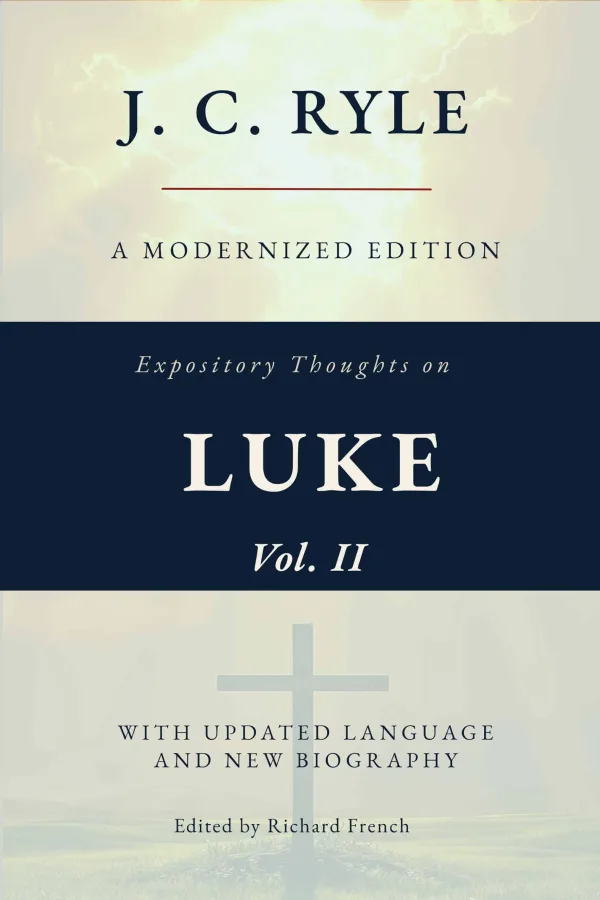
Expository Thoughts on the Gospel of Luke, Vol. II (Annotated), book cover

Commentary

Expository Thoughts on the Gospel of Luke, Vol. II (Annotated)

J. C. Ryle, edited by Richard French

Ryle on Luke 11 to 24, modernized. The journey to Jerusalem, the parables of the lost, the passion and the resurrection, passage by passage.

Ebook $0.99 · Paperback $29.99

Also on Amazon: paperback · Kindle

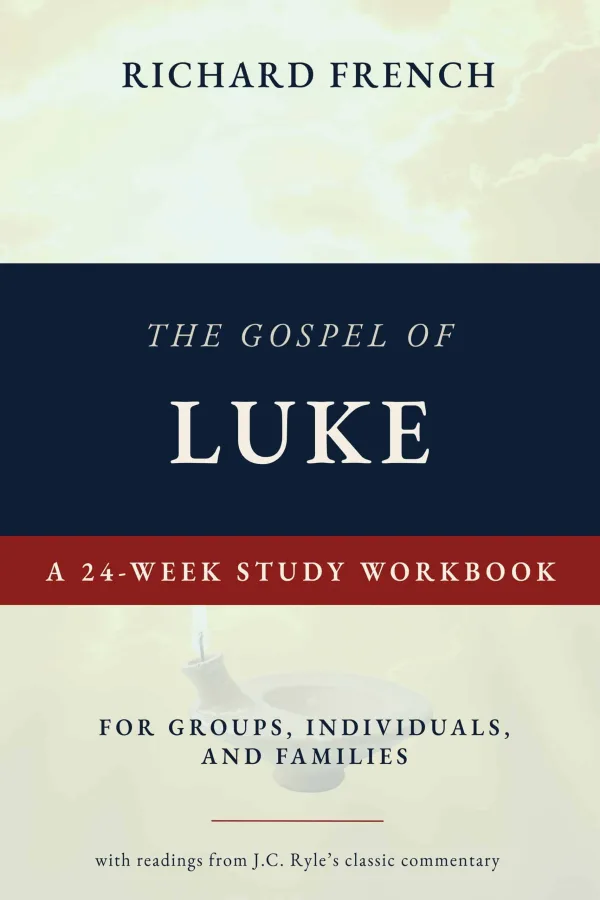
The Gospel of Luke: A 24-Week Study Workbook, book cover

Study workbook

The Gospel of Luke: A 24-Week Study Workbook

Richard French

Twenty-four weeks through Luke, one chapter a week, with Ryle's exposition in each week, questions for groups, the Family Fifteen, and room to write.

Ebook $6.99 · Paperback $21.99 · Spiral-bound $24.99

Also on Amazon: paperback · Kindle

Commentary

Expository Thoughts on the Gospel of John (Annotated)

J. C. Ryle, edited by Richard French

Ryle's commentary on John, modernized, in three volumes. In preparation.

Coming soon

Study workbook

The Gospel of John: A Study Workbook

Richard French

The week-by-week study workbook for John, with Ryle's exposition in each week. In preparation.

Coming soon

See all the books and the group pricing