Gospel Study Guide

The Gospel of Matthew, Explained

The King and his kingdom, from the genealogy to the Great Commission

Matthew in One Paragraph

Matthew stands first in every New Testament, and for most of church history it was the church's favourite Gospel: the one most quoted by the early fathers and the one read most often in worship. It is orderly, it is thorough, and it is built for teaching. If you want to learn what Jesus taught, Matthew is where the church has always started.

Who Wrote Matthew, and When

Like the other three Gospels, Matthew never names its author. The title "According to Matthew" was added by the early church, and the tradition behind it is old. Papias, bishop of Hierapolis, writing around AD 100 to 130, said that "Matthew put together the oracles in the Hebrew language, and each one interpreted them as he was able." Irenaeus, around AD 180, wrote that Matthew "issued a written Gospel among the Hebrews in their own dialect, while Peter and Paul were preaching at Rome." No early writer attributes the book to anyone else.

The Matthew in question is the tax collector of chapter 9:

As Jesus passed by from there, he saw a man called Matthew sitting at the tax collection office. He said to him, "Follow me." He got up and followed him.

Matthew 9:9, World English Bible

Mark and Luke call the same man Levi (Mark 2:14; Luke 5:27). Only this Gospel calls him Matthew in the call story, and only this Gospel adds "the tax collector" to his name in the list of the twelve (Matthew 10:3). A tax collector would have been literate, numerate and used to keeping records, which fits a Gospel so carefully arranged.

Most scholars today think our Greek Matthew used the Gospel of Mark as a source, since about ninety percent of Mark appears in Matthew, often word for word. That has led many to conclude that an unnamed Jewish Christian, writing in Greek, produced the book we have, perhaps drawing on material that went back to the apostle. Others hold to the traditional view that the apostle wrote it. The text itself does not settle the question.

Date

No ancient source dates the book. Scholars who hold that Matthew used Mark usually place it between AD 70 and 85, after the destruction of the temple. Those who think Matthew wrote independently often date it in the 60s, before the temple fell. The only firm boundary is that Ignatius of Antioch, writing around AD 110, already seems to know it.

Written for Whom, and Why

Matthew was written for readers who knew the Old Testament and cared about it: Jewish Christians, and Jews who were weighing the claim that Jesus was the Messiah. Several features of the book make that plain.

  • The genealogy. The book opens with "the genealogy of Jesus Christ, the son of David, the son of Abraham" (Matthew 1:1, WEB). David and Abraham are the two names a Jewish reader needed to hear first.
  • Fulfillment quotations. About a dozen times Matthew pauses the story to say that something happened "that it might be fulfilled which was spoken through the prophet." No other Gospel does this so often. The first is the virgin birth (Matthew 1:22 to 23, quoting Isaiah 7:14).
  • Jewish customs assumed. Mark explains that the Pharisees wash their hands before eating (Mark 7:3 to 4). Matthew, telling the same story, does not (Matthew 15:1 to 2). His readers already knew.
  • "Kingdom of Heaven." Where Mark and Luke say "kingdom of God," Matthew usually says "kingdom of heaven," a reverent way of speaking that avoids the divine name, as devout Jews did.

Why write it? Matthew's own answer is in the last three verses: Jesus has been given all authority, and his disciples are to make disciples of all nations by baptizing and teaching. The book is a teacher's Gospel. It gathers what Jesus taught into blocks a church could learn from, and it shows a Jewish reader that following Jesus is not leaving the Scriptures behind but finding what they were always pointing to.

"Don't think that I came to destroy the law or the prophets. I didn't come to destroy, but to fulfill."

Matthew 5:17, World English Bible

How Matthew Is Organized

Matthew alternates between narrative and teaching. Five times he gathers Jesus' words into a long discourse, and five times he closes it with almost the same sentence: "When Jesus had finished saying these things" (7:28; 11:1; 13:53; 19:1; 26:1). Readers have noticed this pattern for a long time; the American scholar B. W. Bacon made it famous in 1930, and suggested the five blocks echo the five books of Moses. Whether or not that was Matthew's intent, the five discourses are the clearest map of the book.

ChaptersNarrativeDiscourse
1 to 4Genealogy, birth, the Magi, Egypt, John the Baptist, baptism, temptation, first disciples
5 to 7The Sermon on the Mount: the Beatitudes, the law fulfilled, the Lord's Prayer, the two builders
8 to 9Ten miracles, the call of Matthew
10The Mission Discourse: the twelve sent out
11 to 12John's question, woes on the cities, "Come to me," Sabbath disputes, the sign of Jonah
13The Parables of the Kingdom: the sower, the weeds, the mustard seed, the treasure, the pearl, the net
14 to 17Feeding the five thousand, walking on water, Peter's confession, the transfiguration
18The Community Discourse: the lost sheep, the brother who sins, the unforgiving servant
19 to 23Journey to Jerusalem, the triumphal entry, the temple cleansed, disputes, the woes on the scribes and Pharisees
24 to 25The Olivet Discourse: the end of the age, the ten virgins, the talents, the sheep and the goats
26 to 28The Last Supper, Gethsemane, trial, crucifixion, burial, resurrection, the Great Commission

Two other seams are worth knowing. Twice Matthew writes "From that time, Jesus began" (4:17 and 16:21). The first marks the start of the public ministry; the second marks the turn toward the cross. Read with those two hinges, the book has three movements: who Jesus is (1:1 to 4:16), what Jesus proclaims (4:17 to 16:20), and where Jesus is going (16:21 to 28:20).

From that time, Jesus began to preach, and to say, "Repent! For the Kingdom of Heaven is at hand."

Matthew 4:17, World English Bible

Key Themes

Jesus the King

Matthew's first words call Jesus "the son of David," and the royal thread runs to the end. The Magi ask for "he who is born King of the Jews" (2:2). Jesus enters Jerusalem as the king of Zechariah 9:9 (21:5). The charge over the cross reads "This is Jesus, the King of the Jews" (27:37). And the risen Jesus claims "all authority in heaven and on earth" (28:18). The kingdom he preaches is his own.

Fulfillment

Matthew reads the Old Testament as a book of promises that Jesus keeps. The birth fulfills Isaiah, the return from Egypt fulfills Hosea, the ministry in Galilee fulfills Isaiah again, the healings fulfill Isaiah 53, the parables fulfill the Psalms, the entry fulfills Zechariah, and the betrayal money fulfills the prophets. Jesus does not replace the Scriptures; he completes them (5:17).

The Kingdom of Heaven

The phrase occurs about thirty times, and only in Matthew. The kingdom is "at hand" (4:17), it belongs to the poor in spirit (5:3), it grows like a mustard seed (13:31), it is worth selling everything for (13:44 to 46), and its keys are given to Peter (16:19). It is God's rule, breaking in through Jesus, to be completed at the end of the age.

Righteousness that exceeds

Matthew uses the word "righteousness" more than the other Gospels combined. Jesus is baptized "to fulfill all righteousness" (3:15), and he tells his disciples that unless their righteousness exceeds that of the scribes and Pharisees they will not enter the kingdom (5:20). The Sermon on the Mount then shows what that deeper righteousness looks like: not only no murder, but no contempt; not only no adultery, but no lust; not only love for neighbours, but love for enemies.

The church

Matthew is the only Gospel to use the word "church" (16:18; 18:17). Chapter 18 is a manual for life together: humility, care for the straying, how to deal with a brother who sins, and forgiveness without limit. The book ends not with Jesus departing but with Jesus promising to stay: "I am with you always, even to the end of the age" (28:20).
Key Passages

  • The genealogy and birth (1:1 to 2:23). Three sets of fourteen generations, Joseph's dream, the name Immanuel, the Magi, Herod, Egypt and Nazareth.
  • The Sermon on the Mount (5:1 to 7:29). The best-known teaching of Jesus: the Beatitudes, salt and light, the law fulfilled, the Lord's Prayer, the lilies of the field, the narrow gate, the house on the rock. Our guide articles take it a passage at a time.
  • "Come to me" (11:28 to 30). "Come to me, all you who labor and are heavily burdened, and I will give you rest" (11:28, WEB). Found only in Matthew.
  • The parables of the kingdom (13:1 to 52). Seven parables in one chapter, ending with the scribe "who brings out of his treasure new and old things" (13:52, WEB).
  • Peter's confession (16:13 to 20). "You are the Christ, the Son of the living God" (16:16, WEB), and Jesus' reply about the rock, the church and the keys.
  • The Olivet Discourse (24:1 to 25:46). The end of the age, the ten virgins, the talents, and the sheep and the goats. The last two parables are only in Matthew.
  • The passion and resurrection (26:1 to 28:15). Matthew alone records Judas's remorse, Pilate's wife's dream, Pilate washing his hands, the guard at the tomb, and the earthquake.
  • The Great Commission (28:16 to 20).

Jesus came to them and spoke to them, saying, "All authority has been given to me in heaven and on earth. Go and make disciples of all nations, baptizing them in the name of the Father and of the Son and of the Holy Spirit, teaching them to observe all things that I commanded you. Behold, I am with you always, even to the end of the age."

Matthew 28:18 to 20, World English Bible

How Matthew Differs from the Other Gospels

Matthew, Mark and Luke tell the same story in much the same order, which is why they are called the Synoptic Gospels (from a Greek word meaning "seen together"). John stands apart. Within the three, Matthew has a character of its own.

MatthewMarkLukeJohn
Portrait of JesusThe King, son of David, the new Moses who teachesThe Servant who acts, the suffering Son of GodThe Saviour of all, friend of the poor and the outsiderThe eternal Word made flesh
OpeningGenealogy from AbrahamJohn the Baptist, no birth storyBirth of John and Jesus, genealogy back to Adam"In the beginning was the Word"
Length28 chapters16 chapters24 chapters21 chapters
TeachingFive long discoursesLittle extended teachingTeaching spread through a long journey (9:51 to 19:27)Long dialogues and the Farewell Discourse
Old TestamentQuoted most often, with "that it might be fulfilled"Quoted leastQuoted, with an eye to the nationsAlluded to, through signs and feasts
Only hereMagi, flight to Egypt, Peter on the water, the temple tax, the sheep and goats, Pilate's wife, the guard at the tomb, the Great CommissionThe deaf man of Decapolis, the blind man at Bethsaida, the young man who fledThe shepherds, the Good Samaritan, the Prodigal Son, Zacchaeus, the Emmaus roadCana, Nicodemus, the woman at the well, Lazarus, the foot-washing, Thomas

The fuller comparison, with the Synoptic relationship explained, is on the four Gospels page.

How to Study Matthew

  1. Read it through once, quickly. About two and a half hours. Notice the five "when Jesus had finished" seams and the two "from that time" hinges.
  2. Then go a chapter a week. Twenty-eight chapters, twenty-eight weeks. A group that meets through the school year can do it in two terms. Shorter tracks of thirteen and eight weeks are possible if you take the discourses whole.
  3. Keep the Old Testament open. Every time Matthew says "that it might be fulfilled," look up the prophet. The book makes far more sense when you see what it is quoting.
  4. Watch for the word "righteousness." Ask, each time, what kind of righteousness Jesus means.
  5. Read a good old commentary alongside. Ryle's Expository Thoughts on Matthew was written to be read aloud in families, a passage at a time, and it still works that way.
  6. End each study with the question Matthew ends with: what has Jesus commanded, and how will you observe it this week?

Free study sheets. "The Four Gospels at a Glance" puts Matthew beside the other three on one page, and "The Life of Jesus: A Timeline" shows where each chapter falls in the story. Both are free on the free downloads page.

J. C. Ryle on Matthew

John Charles Ryle (1816 to 1900) was an English parish clergyman who became the first Bishop of Liverpool in 1880. His Expository Thoughts on the Gospels began with Matthew in 1856. He wrote it, as he explained in his preface, for family reading: short expositions on each passage, plain enough to read aloud, each drawing out the doctrine, the warning and the comfort in the text. The series went on to Mark, Luke and John, and has stayed in print ever since.

Our edition keeps Ryle's words and his order and modernizes what slows a reader now: the "thee" and "thou," the old spellings, and the Scripture references written out in full. Where a word or a reference needs help, an editor's note says so in brackets. A new biography opens the volume. The books page says more about what changed and what did not.

Sources

  1. The Gospel of Matthew, World English Bible (public domain). Quotations checked against the WEB text.
  2. Papias of Hierapolis, as quoted in Eusebius, Ecclesiastical History 3.39.16.
  3. Irenaeus of Lyons, Against Heresies 3.1.1.
  4. B. W. Bacon, Studies in Matthew (New York: Henry Holt, 1930), on the five discourses.
  5. R. T. France, The Gospel of Matthew, New International Commentary on the New Testament (Grand Rapids: Eerdmans, 2007), introduction, on authorship, date and structure.
  6. D. A. Carson and Douglas J. Moo, An Introduction to the New Testament, 2nd ed. (Grand Rapids: Zondervan, 2005), chapter 4.
  7. J. C. Ryle, Expository Thoughts on the Gospels: St. Matthew (London: William Hunt, 1856), preface.

Frequently Asked Questions

Study Matthew with J. C. Ryle

Ryle's Expository Thoughts on Matthew, modernized and annotated, and the 28-week study workbook that pairs with it.

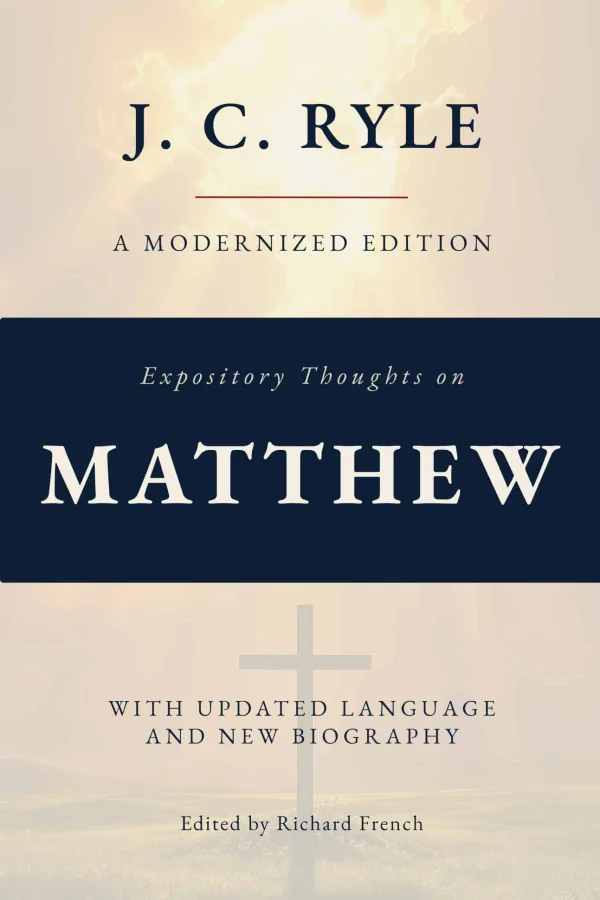
Expository Thoughts on the Gospel of Matthew (Annotated), book cover

Commentary

Expository Thoughts on the Gospel of Matthew (Annotated)

J. C. Ryle, edited by Richard French

Ryle's complete commentary on Matthew, modernized for today's reader. Short expositions on every passage, with his doctrine, warning and comfort in his own order, a new biography, and editor's notes where a word or reference needs help.

Ebook $0.99 · Paperback $21.99

Also on Amazon: paperback · Kindle

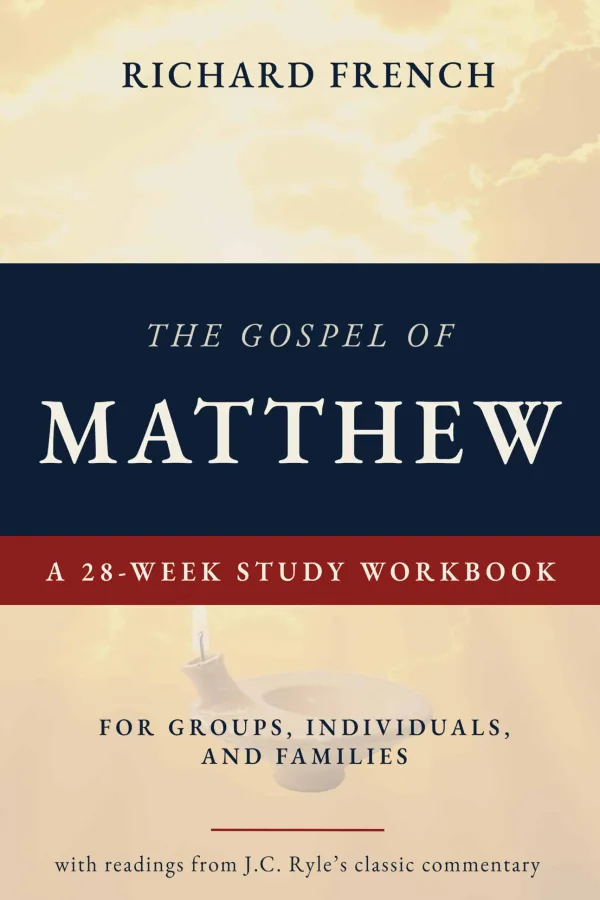
The Gospel of Matthew: A 28-Week Study Workbook, book cover

Study workbook

The Gospel of Matthew: A 28-Week Study Workbook

Richard French

One chapter a week through Matthew, with Ryle's exposition printed in each week, observation and discussion questions, the Family Fifteen for households, and room to write. Tracks for 28, 13 or 8 weeks.

Ebook $6.99 · Paperback $21.99 · Spiral-bound $24.99

Also on Amazon: paperback · Kindle

See all the books and the group pricing