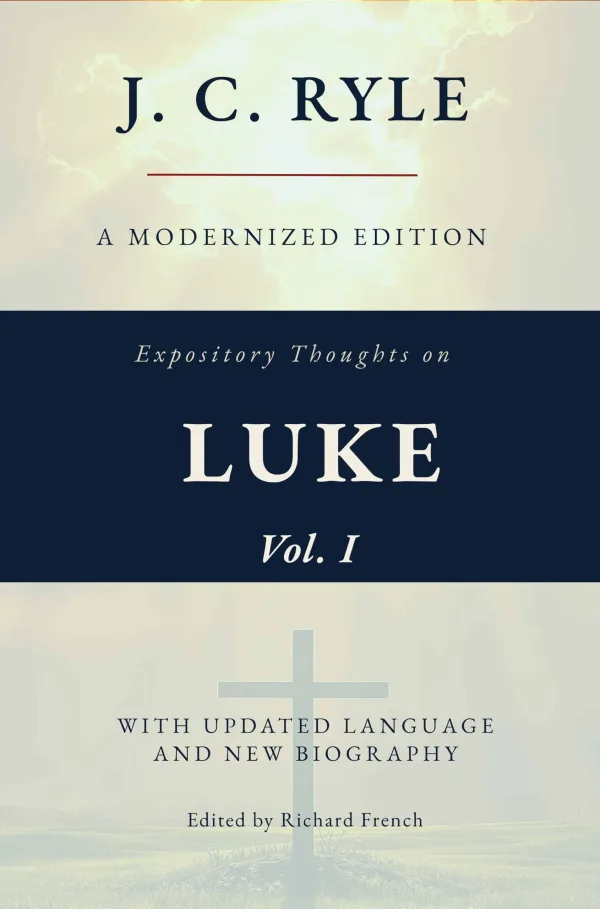
Commentary
Expository Thoughts on the Gospel of Luke, Vol. I (Annotated)
Ryle on Luke 1 to 10, modernized. The birth narratives, the start of the ministry in Galilee, and the sending of the seventy, passage by passage.
Ebook $0.99 · Paperback $21.99
Gospel Study Guide
The Saviour of all, from the shepherds of Bethlehem to the road to Emmaus
The Gospel of Luke presents Jesus as the Saviour of all people, the Son of Man who "came to seek and to save that which was lost" (Luke 19:10, WEB). It is the longest of the four Gospels and the first half of a two-volume work that continues in Acts. Written by a careful historian for a Gentile reader named Theophilus, it opens with the births of John the Baptist and Jesus, follows Jesus on a long journey to Jerusalem full of parables found nowhere else, and ends with the risen Lord opening the Scriptures to his disciples on the road to Emmaus.
If Matthew is the teacher's Gospel, Luke is the storyteller's. Its parables are the ones people remember: the Good Samaritan, the Prodigal Son, the Pharisee and the Tax Collector. Its people are the ones the other Gospels leave out: the shepherds, Simeon and Anna, Zacchaeus, the thief on the cross. And its Jesus eats with sinners, notices widows, praises Samaritans and prays before every great turn in the story. If you want to see the mercy of God with a human face, Luke is where to look.
Luke never names himself, but the early church was in no doubt. Irenaeus, writing around AD 180, said that "Luke also, the companion of Paul, recorded in a book the Gospel preached by him," and the Muratorian Fragment, a list of New Testament books from about the same period, names "Luke, the physician" as the author of the third Gospel. No early writer attributes the book to anyone else.
The Luke in question appears three times in Paul's letters: "Luke, the beloved physician" (Colossians 4:14, WEB), one of Paul's "fellow workers" (Philemon 24), and the companion who stayed when the others had gone: "Only Luke is with me" (2 Timothy 4:11, WEB). The book of Acts, addressed to the same Theophilus, shifts from "they" to "we" at four points (Acts 16:10 to 17; 20:5 to 15; 21:1 to 18; 27:1 to 28:16), which is most simply explained if the author was travelling with Paul on those stretches.
Luke himself tells us what kind of author he was. His preface is one long, balanced Greek sentence, as a trained historian of the period would write:
Since many have undertaken to set in order a narrative concerning those matters which have been fulfilled among us, even as those who from the beginning were eyewitnesses and servants of the word delivered them to us, it seemed good to me also, having traced the course of all things accurately from the first, to write to you in order, most excellent Theophilus; that you might know the certainty concerning the things in which you were instructed.
Luke 1:1 to 4, World English Bible
Three things stand out. He was not an eyewitness, and says so. He used sources, including eyewitness testimony. And he investigated them carefully before writing "in order." Most scholars today think one of those sources was the Gospel of Mark, since most of Mark reappears in Luke, often in the same sequence. A large part of the book, though, is Luke's alone.
No ancient source dates the book. The strongest clue is the ending of Acts, which leaves Paul under house arrest in Rome and never tells what became of him. Scholars who take that as a sign that Acts was finished while Paul was still alive date Luke in the early 60s. Those who hold that Luke used Mark, and that Mark itself was written in the 60s, place Luke in the 70s or 80s. Carson and Moo, and Bock, lean to the earlier date; others prefer the later one.
Luke was written for a Gentile reader named Theophilus, and through him for a wider Gentile church that needed to know its faith rested on solid ground. "Most excellent" is the address Luke uses in Acts for the Roman governors Felix and Festus (Acts 23:26; 24:3; 26:25), so Theophilus was probably a man of some rank who had already been "instructed" in the faith (1:4). Acts is addressed to him too (Acts 1:1): the two books are one work in two volumes.
Several features of the Gospel fit a Gentile audience.
Why write it? Luke gives his own answer in the preface: certainty. Theophilus had been taught the story; Luke wanted him to know it was true. But the message reaches past Theophilus. From the angel's announcement onward, this is good news for everyone:
The angel said to them, “Don’t be afraid, for behold, I bring you good news of great joy which will be to all the people. For there is born to you today, in David’s city, a Savior, who is Christ the Lord.
Luke 2:10 to 11, World English Bible
Luke is organized as a journey. After the birth stories and the ministry in Galilee, the book turns on one sentence at 9:51, where Jesus "intently set his face to go to Jerusalem" (WEB), and from there to 19:27 he is on the road. That long central section, usually called the travel narrative, holds most of the material that is only in Luke. The last movement, from the entry into Jerusalem to the ascension, follows the familiar outline of the passion but adds scenes of its own.
| Chapters | Movement | What happens |
|---|---|---|
| 1:1 to 4 | Preface | Luke's purpose: an orderly account for Theophilus |
| 1:5 to 2:52 | Births and childhood | Gabriel, Zechariah and Elizabeth, Mary, the shepherds, Simeon and Anna, the boy Jesus in the temple |
| 3:1 to 4:13 | Preparation | John the Baptist, the baptism, the genealogy back to Adam, the temptation |
| 4:14 to 9:50 | Ministry in Galilee | The Nazareth sermon, the first disciples, the Sermon on the Plain, the widow of Nain, the sinful woman, Peter's confession, the transfiguration |
| 9:51 to 19:27 | The journey to Jerusalem | The Good Samaritan, Martha and Mary, the Rich Fool, the lost sheep, coin and son, the Rich Man and Lazarus, the Pharisee and the Tax Collector, Zacchaeus |
| 19:28 to 21:38 | Jerusalem | The entry, Jesus weeps over the city, the temple cleansed, disputes, the discourse on the temple's fall |
| 22:1 to 23:56 | Passion | The Last Supper, Gethsemane, Peter's denial, Pilate and Herod, the crucifixion, the penitent thief, burial |
| 24:1 to 53 | Resurrection | The empty tomb, the road to Emmaus, the appearance in Jerusalem, the Scriptures opened, the ascension |
One passage near the start acts as the programme for the whole book. In the synagogue at Nazareth, Jesus reads from Isaiah and tells the congregation that the words are fulfilled in their hearing (4:16 to 30). Every theme of Luke is already in the reading: the Spirit, good news for the poor, release, sight, and a favour that will reach even to Gentiles, which is why the sermon ends with the crowd trying to throw him off a cliff.
“The Spirit of the Lord is on me, because he has anointed me to preach good news to the poor. He has sent me to heal the broken hearted, to proclaim release to the captives, recovering of sight to the blind, to deliver those who are crushed, and to proclaim the acceptable year of the Lord.”
Luke 4:18 to 19, World English Bible
Of the three Synoptic Gospels, only Luke calls Jesus a Saviour: "a Savior, who is Christ the Lord" (2:11, WEB). The genealogy reaches Adam, Simeon speaks of light for the nations, and the book ends with the command that repentance and forgiveness be preached "to all the nations, beginning at Jerusalem" (24:47, WEB). Acts then shows it happening.
Mary sings that God has "filled the hungry with good things" and "sent the rich away empty" (1:53, WEB). Luke's Beatitudes bless "you who are poor" (6:20), not "the poor in spirit," and they are matched by woes on the rich (6:24). The Rich Fool, the Rich Man and Lazarus, and the rich ruler who went away sad (18:23) all carry the same warning, and Zacchaeus, who gives half his goods to the poor, shows the way through.
Elizabeth, Mary and Anna fill the first two chapters. The widow of Nain (7:11 to 17), the sinful woman who washed Jesus' feet (7:36 to 50), the women who supported him from their own means (8:1 to 3), Martha and Mary (10:38 to 42) and the bent woman healed on the Sabbath (13:10 to 17) are all found only in Luke.
Luke shows Jesus praying at his baptism (3:21), before choosing the Twelve (6:12), before Peter's confession (9:18), in Gethsemane (22:41 to 44) and on the cross (23:34, 46). Two parables on persistent prayer, the friend at midnight (11:5 to 8) and the unjust judge (18:1 to 8), are only in Luke. The Holy Spirit fills Elizabeth and Zechariah before Jesus is born, comes on Jesus at the Jordan and anoints him at Nazareth. Acts picks the thread up at Pentecost.
Luke begins with Gabriel promising "joy and gladness" (1:14) and ends with the disciples returning to Jerusalem "with great joy" (24:52). Meals run all through the book: Levi's banquet, the Pharisees' dinners, Zacchaeus's table, the Last Supper and the bread broken at Emmaus. Jesus is called "a gluttonous man, and a drunkard; a friend of tax collectors and sinners" (7:34, WEB), and Luke seems glad to record it.
Chapter 15 is Luke's heart: a lost sheep, a lost coin and a lost son, each found, each the occasion of a party. The father who runs is the God of Luke:
“He arose, and came to his father. But while he was still far off, his father saw him, and was moved with compassion, and ran, and fell on his neck, and kissed him.
Luke 15:20, World English Bible
Then he opened their minds, that they might understand the Scriptures. He said to them, “Thus it is written, and thus it was necessary for the Christ to suffer and to rise from the dead the third day, and that repentance and remission of sins should be preached in his name to all the nations, beginning at Jerusalem.
Luke 24:45 to 47, World English Bible
Luke, Matthew and Mark tell the same story in much the same order, which is why they are called the Synoptic Gospels. John stands apart. Within the three, Luke has the most material of its own, the widest cast, and the only sequel.
| Matthew | Mark | Luke | John | |
|---|---|---|---|---|
| Portrait of Jesus | The King, son of David, the new Moses who teaches | The Servant who acts, the suffering Son of God | The Saviour of all, friend of the poor and the outsider | The eternal Word made flesh |
| Opening | Genealogy from Abraham | John the Baptist, no birth story | A historian's preface, then the births of John and Jesus; genealogy back to Adam | "In the beginning was the Word" |
| Length | 28 chapters | 16 chapters | 24 chapters, the longest by word count | 21 chapters |
| Teaching | Five long discourses | Little extended teaching | Parables spread through a long journey (9:51 to 19:27) | Long dialogues and the Farewell Discourse |
| Reader in mind | Jewish Christians | Gentile Christians, probably in Rome | Theophilus and the Gentile church | "That you may believe" (20:31) |
| Only here | Magi, flight to Egypt, Peter on the water, the sheep and goats, the Great Commission | The deaf man of Decapolis, the blind man at Bethsaida, the young man who fled | The shepherds, Simeon and Anna, the Good Samaritan, Martha and Mary, the Prodigal Son, the Rich Man and Lazarus, Zacchaeus, the penitent thief, the Emmaus road | Cana, Nicodemus, the woman at the well, Lazarus, the foot-washing, Thomas |
| Sequel | None | None | The Acts of the Apostles | None |
The fuller comparison, with the Synoptic relationship explained, is on the four Gospels page.
Free study sheets. "The Four Gospels at a Glance" puts Luke beside the other three on one page, and "The Life of Jesus: A Timeline" shows where each chapter falls in the story. Both are free on the free downloads page.
John Charles Ryle (1816 to 1900) was an English parish clergyman who became the first Bishop of Liverpool in 1880. His Expository Thoughts on the Gospels began with Matthew in 1856 and went on to Mark, and then to Luke, which he published in two volumes in 1858 and 1859. He wrote the series for family reading: short expositions on each passage, plain enough to read aloud, each drawing out the doctrine, the warning and the comfort in the text.
Our edition keeps Ryle's words and his order and modernizes what slows a reader now: the "thee" and "thou," the old spellings, and the Scripture references written out in full. Where a word or a reference needs help, an editor's note says so in brackets. The commentary comes in two volumes, as Ryle published it: Volume I covers Luke 1 to 10 and Volume II covers Luke 11 to 24. The books page says more about what changed and what did not.
The book does not name its author, but the early church was unanimous that it was Luke, the physician who travelled with Paul (Colossians 4:14; Philemon 24; 2 Timothy 4:11). Irenaeus, around AD 180, and the Muratorian Fragment, from about the same period, both name him. The "we" passages of Acts, where the narrator joins Paul's journeys, fit a companion of Paul, and no ancient source proposes anyone else.
Estimates fall in two ranges. Scholars who note that Acts ends with Paul still alive in Rome often date Luke in the early 60s. Those who think Luke used Mark as a source, and that Mark was written in the 60s, usually place Luke in the 70s or 80s. No ancient source gives a date.
Luke says so himself in his preface: he wrote "that you might know the certainty concerning the things in which you were instructed" (Luke 1:4, WEB). Theophilus was probably a Gentile believer of some standing, since Luke calls him "most excellent," the title he uses elsewhere for Roman governors (Acts 23:26; 24:3; 26:25). Acts is addressed to the same man (Acts 1:1), so Luke and Acts are two volumes of one work.
The Good Samaritan (10:25 to 37), the Rich Fool (12:13 to 21), the Prodigal Son (15:11 to 32), the Rich Man and Lazarus (16:19 to 31), the Unjust Judge (18:1 to 8) and the Pharisee and the Tax Collector (18:9 to 14), among others. Most of them come in the long travel narrative of chapters 9 to 19, which is why that stretch of Luke is so often read and preached.
Luke is the longest of the four, the only one with a sequel (Acts), and the one most concerned with people on the edge: the poor, women, Samaritans, Gentiles, tax collectors and sinners. Only Luke has the shepherds, Simeon and Anna, the boy Jesus in the temple, Zacchaeus, the penitent thief and the Emmaus road. See the full comparison on the four Gospels page.
Luke has 24 chapters. Read straight through, it takes about two and a half to three hours. Studied a chapter a week with a group, it takes 24 weeks, which is how the Luke study workbook is laid out, and it is why Ryle's commentary on Luke comes in two volumes: Luke 1 to 10 in the first, Luke 11 to 24 in the second.
Ryle's Expository Thoughts on Luke, modernized and annotated in two volumes (Luke 1 to 10 and Luke 11 to 24), and the 24-week study workbook that pairs with them.
Commentary
Ryle on Luke 1 to 10, modernized. The birth narratives, the start of the ministry in Galilee, and the sending of the seventy, passage by passage.
Ebook $0.99 · Paperback $21.99
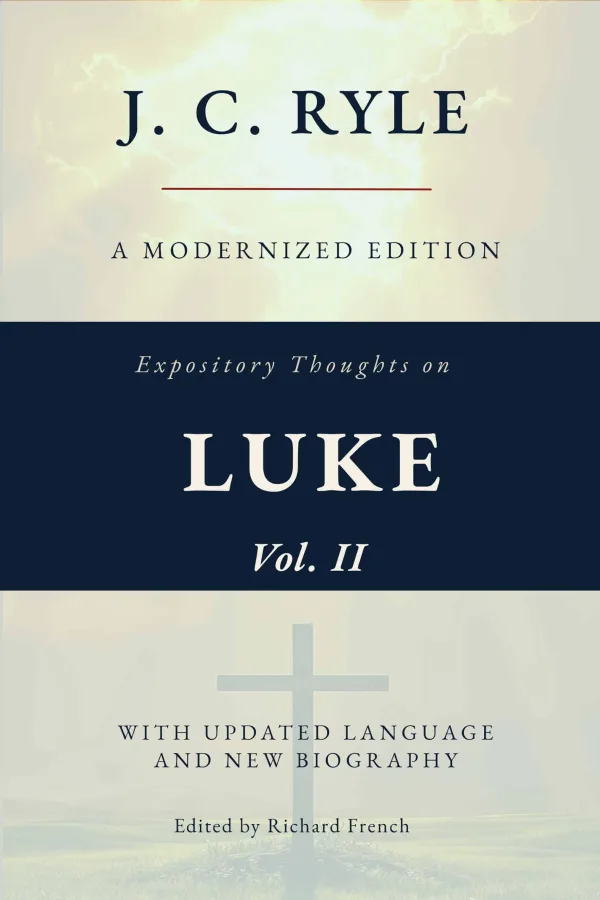
Commentary
Ryle on Luke 11 to 24, modernized. The journey to Jerusalem, the parables of the lost, the passion and the resurrection, passage by passage.
Ebook $0.99 · Paperback $29.99
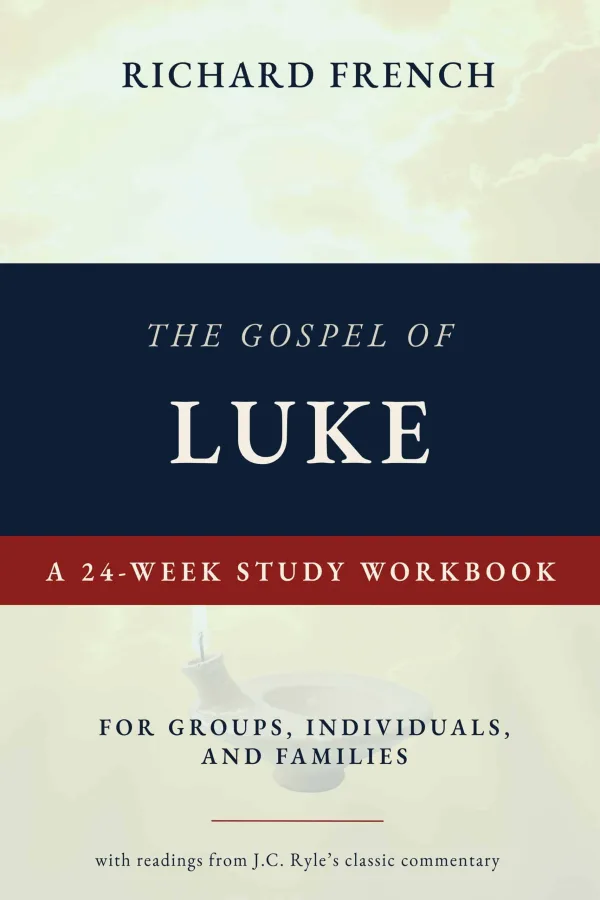
Study workbook
Twenty-four weeks through Luke, one chapter a week, with Ryle's exposition in each week, questions for groups, the Family Fifteen, and room to write.
Ebook $6.99 · Paperback $21.99 · Spiral-bound $24.99