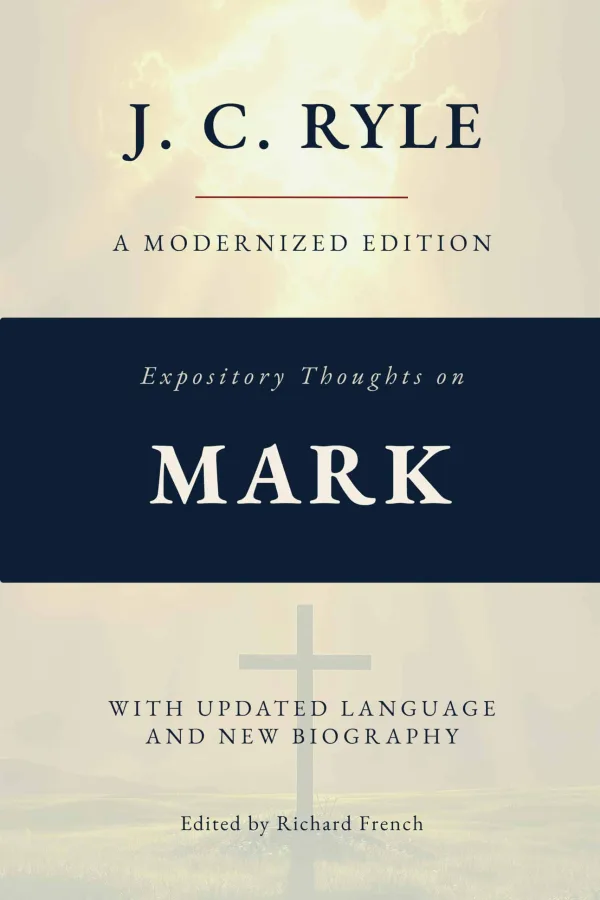
Commentary
Expository Thoughts on the Gospel of Mark (Annotated)
Ryle's commentary on the shortest Gospel, modernized. Every passage of Mark expounded in order, with a new biography and editor's notes.
Ebook $0.99 · Paperback $21.99
Gospel Study Guide
The Servant who came to give his life, from the Jordan to the empty tomb
The Gospel of Mark presents Jesus as the Son of God who comes as a servant, acts with authority over sickness, demons, nature and sin, and goes deliberately to the cross to give his life as a ransom for many. It is the shortest of the four Gospels, and the fastest. It skips the birth of Jesus, opens at the Jordan with John the Baptist, and moves from scene to scene with the word "immediately." Halfway through, Peter confesses that Jesus is the Christ, and from that moment the road leads to Jerusalem and the cross.
For most of church history Mark was the least read of the four, because it looked like a shorter Matthew. That has reversed: most scholars now think Mark was written first and that Matthew and Luke both used it, which makes it the oldest account we have of the life of Jesus. It is also the Gospel for Year B of the Revised Common Lectionary, which begins in Advent 2026. If you want to meet Jesus as the first readers met him, in action, Mark is where to start.
Like the other Gospels, Mark never names its author. The title "According to Mark" was added by the early church, and the tradition behind it is old. Papias, bishop of Hierapolis, writing in the early second century, passed on what he had heard from an elder: that Mark had been Peter's interpreter, and wrote down accurately, though not in order, what he remembered of the Lord's words and deeds. Mark had not heard the Lord himself, Papias adds, but had followed Peter. Irenaeus, around AD 180, says that after the departure of Peter and Paul, Mark, "the disciple and interpreter of Peter," handed down in writing what Peter had preached. Clement of Alexandria, a little later, adds that Mark wrote in Rome at the request of Peter's hearers.
The Mark in question is usually taken to be John Mark of Jerusalem, in whose mother's house the church met (Acts 12:12). He went with Barnabas and Paul on their first journey and turned back at Perga (Acts 13:13), which later divided the two apostles (Acts 15:37 to 39). Paul was in time reconciled to him (2 Timothy 4:11; Philemon 24), and Peter sends greetings from "Mark, my son" (1 Peter 5:13). A man who had failed once and been restored, and who had Peter's preaching in his ears, fits the book well.
The Gospel opens without a birth story or a preface, with a sentence that is also its title:
The beginning of the Good News of Jesus Christ, the Son of God.
Mark 1:1, World English Bible
Most scholars today think Mark was the first Gospel written and that Matthew and Luke both had it in front of them: nearly all of Mark appears in Matthew, most of it in Luke, and it is easier to explain the other two smoothing Mark's plain Greek and adding teaching than to explain Mark cutting the Sermon on the Mount out of Matthew. Some still hold the older view that Matthew came first. The question does not change what Mark says.
No ancient source dates the book. Irenaeus places it after the deaths of Peter and Paul, which points to the late 60s. Most scholars date it in the 60s or around AD 70, the chief debate being whether chapter 13, with its prophecy of the temple's destruction, was written before or just after the temple fell.
Mark was written for readers who did not speak Aramaic or share Jewish customs: for Gentile Christians, most likely in Rome, as the early church said. The book shows it throughout.
Taking the child by the hand, he said to her, “Talitha cumi!” which means, being interpreted, “Girl, I tell you, get up!”
Mark 5:41, World English Bible
Why write it? If Clement is right, Peter's hearers in Rome asked for a written record of his preaching, and Mark gave them one. The book reads like preaching: short scenes, vivid detail, little comment, and a steady pressure toward the cross. Readers facing hardship for Jesus' name, as Christians in Rome did under Nero, would see that the one they followed had walked the road of suffering first, and on purpose.
Mark falls into two halves, and the hinge is Peter's confession at Caesarea Philippi (8:29). The first half, in and around Galilee, keeps asking "Who is this?" The second answers it and shows what it costs: Jesus turns toward Jerusalem, tells the disciples three times that the Son of Man must suffer and die (8:31; 9:31; 10:33 to 34), and then does exactly that.
| Chapters | Section | What happens |
|---|---|---|
| 1:1 to 13 | Prologue | John the Baptist, the baptism of Jesus, the voice from heaven, the temptation in the wilderness |
| 1:14 to 3:6 | Galilee: the first disciples and the first conflicts | "The Kingdom of God is at hand," four fishermen called, a day in Capernaum, the paralytic forgiven, Levi called, Sabbath disputes, a plot to kill him |
| 3:7 to 6:6 | Galilee: the Twelve, the parables, the power | The Twelve appointed, "Who are my mother and my brothers?", the parables of the sower and the seed, the storm stilled, the Gerasene demoniac, Jairus's daughter and the bleeding woman, rejection at Nazareth |
| 6:7 to 8:30 | Beyond Galilee: bread, blindness and the question | The Twelve sent out, John beheaded, the five thousand fed, walking on the sea, clean and unclean, the Syrophoenician woman, the deaf man, the four thousand fed, the blind man at Bethsaida, Peter's confession |
| 8:31 to 10:52 | On the way to Jerusalem | Three passion predictions, the transfiguration, the boy with the unclean spirit, who is greatest, divorce, the children, the rich man, James and John's request, the ransom saying, blind Bartimaeus |
| 11 to 13 | Jerusalem: the temple | The entry, the fig tree, the temple cleared, the question of authority, the vineyard, Caesar's coin, the resurrection question, the great commandment, the widow's coins, the Olivet Discourse |
| 14 to 15 | The passion | The anointing at Bethany, the Last Supper, Gethsemane, the arrest, the trial before the council, Peter's denial, Pilate, the crucifixion, the centurion's confession, the burial |
| 16:1 to 8 | The empty tomb | The women find the stone rolled away and a young man who tells them Jesus is risen and has gone ahead to Galilee |
Three habits of Mark's help a reader keep their bearings. The word "immediately" (Greek euthys) occurs about forty times and keeps the story moving. Mark likes to put one story inside another, so that each explains the other: the bleeding woman on the way to Jairus's daughter (5:21 to 43), the temple cleared between the cursing and withering of the fig tree (11:12 to 25), Peter's denial around Jesus' confession before the council (14:53 to 72). And the road to Jerusalem is framed by two blind men who receive their sight, at Bethsaida (8:22 to 26) and at Jericho (10:46 to 52), with the disciples in between slowly learning to see.
He said to them, “But who do you say that I am?” Peter answered, “You are the Christ.”
Mark 8:29, World English Bible
Mark tells his readers who Jesus is in the first verse, then lets the title be spoken only at the turning points: by the voice from heaven at the baptism (1:11) and the transfiguration (9:7), by demons who are silenced (3:11; 5:7), by the high priest's question and Jesus' answer "I am" (14:61 to 62), and at last by a Roman centurion watching him die: "Truly this man was the Son of God!" (15:39). The Son of God is seen most clearly at the cross.
The sentence that sums up the book comes after James and John have asked for the best seats in the kingdom. The great among you must be the servant of all, Jesus says, and gives the reason:
For the Son of Man also came not to be served, but to serve, and to give his life as a ransom for many.”
Mark 10:45, World English Bible
Six of Mark's sixteen chapters are given to the last week of Jesus' life, and the three passion predictions make certain that no reader can think the cross was an accident.
Jesus in Mark keeps telling people to be quiet: the demons who name him (1:34; 3:12), the healed leper (1:44), Jairus's household (5:43), the crowd in the Decapolis (7:36), the disciples after Peter's confession (8:30), and the three on the mountain, "until after the Son of Man had risen from the dead" (9:9). That last command is the explanation. Jesus could not be rightly understood as Messiah until he had been seen as the crucified and risen one. A Messiah announced too early would have been the wrong Messiah.
No Gospel is harder on the Twelve. They are afraid in the storm (4:40), their hearts are hardened after the loaves (6:52; 8:17 to 21), they do not understand the passion predictions (9:32), they argue about who is greatest (9:34) and ask for thrones (10:37), and at the arrest, "They all left him, and fled" (14:50). Yet Jesus keeps them, and after the resurrection sends word that he will meet them in Galilee, naming Peter (16:7). Mark's first readers, facing their own failures under pressure, would have taken the point.
Jesus' first words in Mark are a summary of his preaching:
Now after John was taken into custody, Jesus came into Galilee, preaching the Good News of God’s Kingdom, and saying, “The time is fulfilled, and God’s Kingdom is at hand! Repent, and believe in the Good News.”
Mark 1:14 to 15, World English Bible
The kingdom in Mark is shown more than explained: in the authority with which Jesus teaches, casts out demons, forgives sins and stills the sea, and in the parables of chapter 4, where it grows secretly from a small seed. It is entered as a child enters (10:14 to 15).
They went out, and fled from the tomb, for trembling and astonishment had come on them. They said nothing to anyone; for they were afraid.
Mark 16:8, World English Bible
That is where the two oldest complete manuscripts of the New Testament, Sinaiticus and Vaticanus, end the book. The longer ending printed as 16:9 to 20 is found in most later manuscripts, but most scholars think it was added to supply a conclusion. Whether Mark meant to stop at verse 8 or his own ending was lost is still debated. What is not in doubt is that the tomb was empty and the young man said "He has risen."
Matthew, Mark and Luke tell the same story in much the same order, which is why they are called the Synoptic Gospels (from a Greek word meaning "seen together"). On the usual view Mark is the source the other two drew on, so what is distinctive is what Mark leaves out, what only Mark includes, and how he tells it.
| Matthew | Mark | Luke | John | |
|---|---|---|---|---|
| Portrait of Jesus | The King, son of David, the new Moses who teaches | The Servant who acts, the suffering Son of God | The Saviour of all, friend of the poor and the outsider | The eternal Word made flesh |
| Opening | Genealogy from Abraham | John the Baptist, no birth story | Birth of John and Jesus, genealogy back to Adam | "In the beginning was the Word" |
| Length | 28 chapters | 16 chapters | 24 chapters | 21 chapters |
| Teaching | Five long discourses | Little extended teaching; two discourses (chapters 4 and 13) | Teaching spread through a long journey (9:51 to 19:27) | Long dialogues and the Farewell Discourse |
| Old Testament | Quoted most often, with "that it might be fulfilled" | Quoted least; Jewish customs explained, Aramaic translated | Quoted, with an eye to the nations | Alluded to, through signs and feasts |
| Pace | Measured, arranged for teaching | Fast: "immediately" about forty times | Orderly, with a long central journey | Slow, with long scenes and conversations |
| Only here | Magi, flight to Egypt, Peter on the water, the temple tax, the sheep and goats, Pilate's wife, the guard at the tomb, the Great Commission | The seed growing secretly, the deaf man of Decapolis, the blind man at Bethsaida, the young man who fled | The shepherds, the Good Samaritan, the Prodigal Son, Zacchaeus, the Emmaus road | Cana, Nicodemus, the woman at the well, Lazarus, the foot-washing, Thomas |
The fuller comparison, with the Synoptic relationship explained, is on the four Gospels page.
Free study sheets. "The Four Gospels at a Glance" puts Mark beside the other three on one page, and "The Life of Jesus: A Timeline" shows where each chapter falls in the story. Both are free on the free downloads page.
John Charles Ryle (1816 to 1900) was an English parish clergyman who became the first Bishop of Liverpool in 1880. His Expository Thoughts on the Gospels began with Matthew in 1856, and the volume on Mark followed in 1857. He wrote it, as he had the first, for family reading: short expositions on each passage, plain enough to read aloud, each drawing out the doctrine, the warning and the comfort in the text. Mark's short, vivid scenes suit the method well. The series went on to Luke and John and has stayed in print ever since.
Our edition keeps Ryle's words and his order and modernizes what slows a reader now: the "thee" and "thou," the old spellings, and the Scripture references written out in full. Where a word or a reference needs help, an editor's note says so in brackets. A new biography opens the volume. The books page says more about what changed and what did not.
The book does not name its author. The earliest witness, Papias of Hierapolis in the early second century, said that Mark had been Peter's interpreter and wrote down accurately, though not in order, what he remembered of Peter's preaching. Irenaeus and Clement of Alexandria say the same. The Mark in question is usually taken to be John Mark of Jerusalem, the companion of Barnabas, Paul and Peter in Acts and the letters.
Most scholars place it in the 60s or around AD 70, which would make it the earliest of the four Gospels. Irenaeus connects it with the time after Peter and Paul had died in Rome, which points to the late 60s. No ancient source gives a year.
Mark has 16 chapters, against Matthew's 28, Luke's 24 and John's 21. It has no birth story and very little extended teaching: no Sermon on the Mount, and only two long discourses (the parables in chapter 4 and the Olivet Discourse in chapter 13). What it keeps is action. Mark tells fewer stories than Matthew and Luke but often tells them at greater length and with more detail.
Again and again in Mark, Jesus silences demons, tells the people he has healed not to spread the news, and orders the disciples not to say who he is (Mark 1:34; 1:44; 3:12; 5:43; 7:36; 8:30; 9:9). Scholars call this the "messianic secret." The simplest reading is that Jesus did not want to be known as a wonder-worker or a political Messiah before the cross had shown what kind of Messiah he was. After the resurrection the silence is lifted.
The two oldest complete copies of the Greek New Testament, Codex Sinaiticus and Codex Vaticanus, both end Mark at 16:8, with the women fleeing the tomb in fear. The longer ending, verses 9 to 20, appears in most later manuscripts and has been read in church since early times, but most scholars think it was added by a later hand. Nothing in Christian teaching depends on it alone; everything in it is found elsewhere in the New Testament.
Mark has 16 chapters. Read straight through, it takes about an hour and a half, which is why it is often read aloud in a single sitting. Studied a chapter a week with a group, it takes 16 weeks, which is how the Mark study workbook is laid out, with shorter 8-week and 6-week tracks for groups that need them.
Ryle's Expository Thoughts on Mark, modernized and annotated, and the 16-week study workbook that pairs with it.
Commentary
Ryle's commentary on the shortest Gospel, modernized. Every passage of Mark expounded in order, with a new biography and editor's notes.
Ebook $0.99 · Paperback $21.99
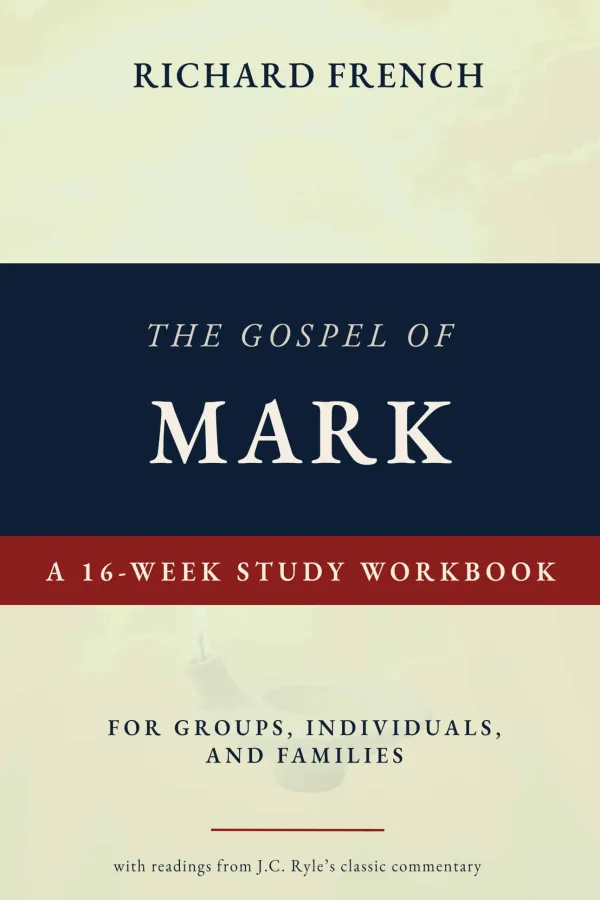
Study workbook
Sixteen weeks through Mark, one chapter a week, with Ryle's exposition in each week, questions for groups, the Family Fifteen, and room to write. Tracks for 16, 8 or 6 weeks.
Ebook $6.99 · Paperback $19.99 · Spiral-bound $21.99