Before Jesus even begins the story, Luke tells us what it means. He says Jesus "spake a parable unto them to this end, that men ought always to pray, and not to faint" (KJV Luke 18:1). The Luke 18:1-8 meaning is settled before the first character appears. As Ryle notes, citing an old divine, "The key hangs at the door."
Maybe you have prayed for the same thing for months or years and wondered whether anyone is listening. This parable speaks to that weariness. It follows Jesus' teaching on the coming of the Son of Man in Luke 17, where he warns his disciples of a long, hard interval before his return. The parable of the persistent widow is not a technique for getting prayers answered faster. It specifically teaches perseverance in prayer grounded in who God is, rather than in how long or loud we ask.
Let's look at the passage verse by verse: the judge, the widow, the Lord's own application, the question about faith at the end, the main views Christians hold, and what Ryle draws from it.
Quick Answer: The Luke 18:1-8 meaning is a call to persevering prayer grounded in God's character. Jesus sets an unjust judge beside a persistent widow and argues from lesser to greater. If a callous judge finally gives justice to a woman who keeps asking, God will surely avenge "his own elect, which cry day and night unto him" (KJV Luke 18:7).
Definition: The parable of the persistent widow in Luke's Gospel represents Jesus' teaching that disciples should keep praying without losing heart while they wait for God to act on their behalf.
Key Scripture: "And shall not God avenge his own elect, which cry day and night unto him, though he bear long with them?" (KJV Luke 18:7)
Key Evidence: As J. C. Ryle writes, "It is prayer without fainting, during the long weary interval between the first and second advents, which Jesus is urging His disciples to keep up" (commentary on Luke 18:1-8).
Context: The parable closes Jesus' teaching on the day of the Son of Man (Luke 17:20-37), so its subject is prayer during the wait for his return.
This parable answers the question every waiting believer eventually asks: is it worth continuing to pray when nothing seems to change? It works by contrast, moving from a worst-case human judge to the best possible heavenly one. The implication is that delay does not mean denial, and persistence in prayer is itself a mark of faith. The sections below walk through the judge, the widow, Jesus' application, the differing views Christians hold on difficult phrases, and what Ryle draws from the text.
Key Takeaways
- Stated purpose: Luke 18:1 gives the parable's aim. Disciples should pray "always" and "not to faint" (KJV Luke 18:1).
- Lesser to greater: The unjust judge yields only to stop being bothered. God acts from justice and love.
- Justice for the helpless: The widow asks to be avenged of a real wrong. Scripture names God as the defender of widows.
- Elect who cry to God: Ryle calls God's chosen "essentially a praying people."
- Searching question: Verse 8 asks whether faith will endure until the Son of Man comes.
Luke 18:1-8 Meaning in Verses 1 to 5: The Judge and the Widow
The Luke 18:1-8 meaning begins with Luke's own introduction in verse 1.
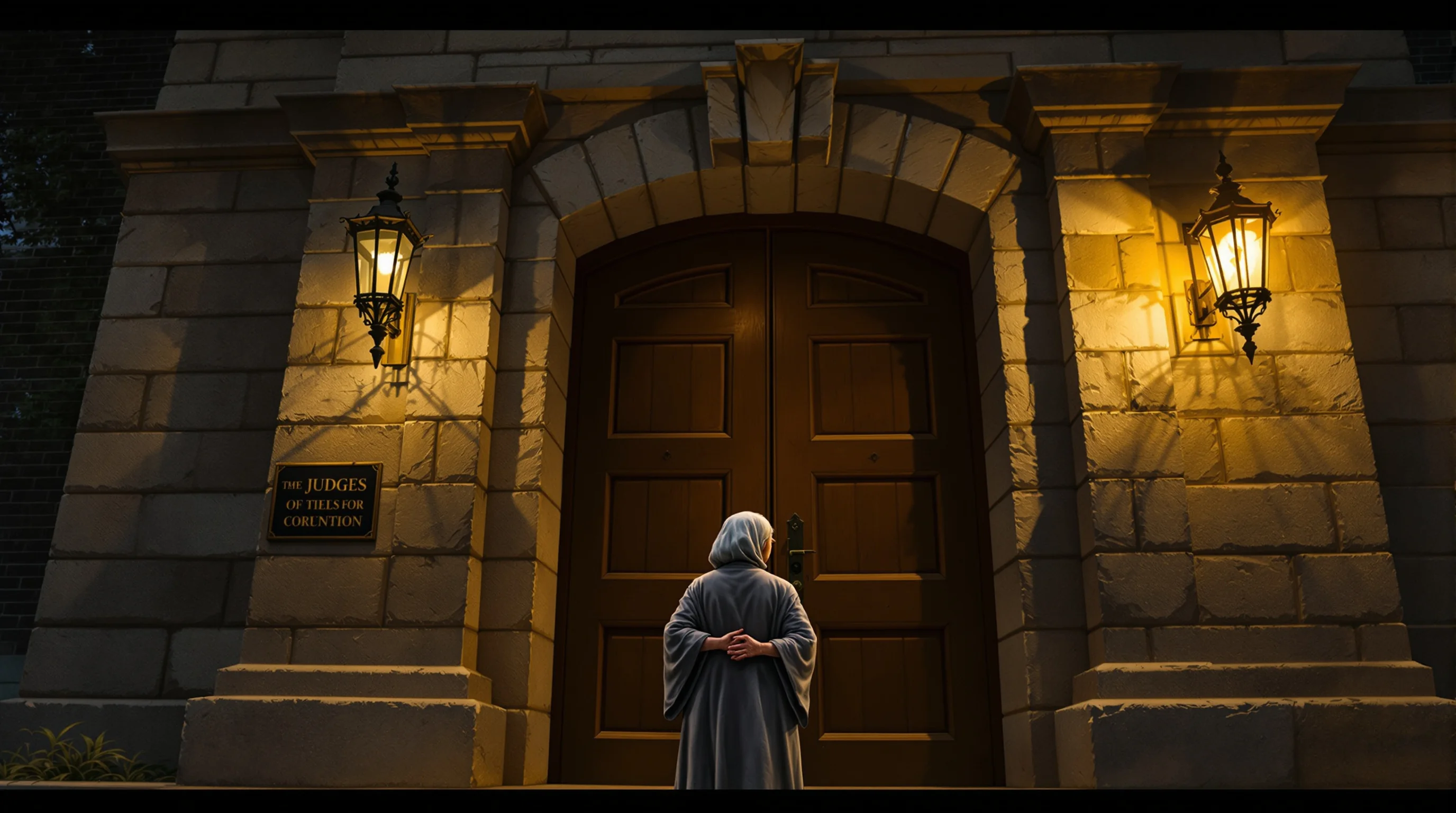
Verse 2 describes the judge in stark terms: he "feared not God, neither regarded man" (KJV Luke 18:2). He answers to no one, human or divine, and that is exactly the point. Jesus builds his whole argument on this bleak figure having no reason to help anyone.
The widow's plea in verse 3, "Avenge me of mine adversary" (KJV Luke 18:3), is a request for legal justice, not a favor. In verses 4 and 5, the judge "would not for a while" (KJV Luke 18:4), then relents "lest by her continual coming she weary me" (KJV Luke 18:5). He gives in from self-protection, with no change of heart at all. Her only resources are a just cause and a refusal to stop asking.
Setting After Luke 17
Verses 1 through 8 follow directly on Jesus' warning about the days of the Son of Man.

- The wait: "ye shall desire to see one of the days of the Son of man, and ye shall not see it" (KJV Luke 17:22).
- Ryle's link: He ties the parable to the second coming of Christ, connecting it to the chapter before.
Widows and Judges in Scripture
Jesus' first hearers already knew that God had taken up the widow's cause long before this parable was told.
- The Law: "Ye shall not afflict any widow, or fatherless child" (KJV Exodus 22:22); God "doth execute the judgment of the fatherless and widow" (KJV Deuteronomy 10:18).
- The Prophets: "judge the fatherless, plead for the widow" (KJV Isaiah 1:17). The judge in the parable is the kind of official the prophets condemned.
The Lord's Application in Verses 6 to 8
In verse 6, Jesus says, "Hear what the unjust judge saith" (KJV Luke 18:6), drawing deliberate attention back to the judge's own reluctant words. The contrast with God stands out because the judge's motive was so low.
Verse 7 names God's people as "his own elect" (KJV Luke 18:7), those he knows and defends personally. Abraham's question stands behind this verse: "Shall not the Judge of all the earth do right?" (KJV Genesis 18:25). Verse 8 promises he "will avenge them speedily" (KJV Luke 18:8), a word readers take in several ways, covered in a later section.
The parable closes with a question rather than a promise: "when the Son of man cometh, shall he find faith on the earth?" (KJV Luke 18:8). That question turns the story toward the hearer. Persistent prayer is the visible form of faith that has not given up. Luke 18:7 grounds the believer's confidence in God's character as the Righteous Judge who hears his people day and night.
Paired With the Pharisee and Publican
Luke places the parable of the Pharisee and the publican (Luke 18:9-14) immediately after this one, and the pairing is deliberate.
- Audience: It is spoken "unto certain which trusted in themselves that they were righteous, and despised others" (KJV Luke 18:9).
- Together: The widow models persistence in asking, and the publican models the humility of the one God hears. The prodigal son parable in Luke 15 shows the same Father receiving those who come to him honestly.
How Christians Read Luke 18:1-8 Differently
Faithful readers, J. C. Ryle among them, have wrestled with this parable for centuries and reach different conclusions on several phrases. Here are the main views, laid out fairly.
On "speedily" in verse 8 (KJV Luke 18:8), some read it as "soon," others as "suddenly," and others as "surely and decisively," meaning God acts without final delay even when the wait feels long. Ryle tied it to the second coming, which seems long delayed to us though a thousand years are as one day with God.
The closing question in verse 8 is read two ways. Some find it sobering, and Ryle concludes that true faith will be found very scarce at the end of the world. Others take it as an open invitation to keep trusting, with no forecast of widespread failure built in. Some read "the Son of man cometh" as the fall of Jerusalem in AD 70, a view Ryle mentions and rejects.
On "faith" itself, some take the word as saving faith in general, while others read it as faithfulness specifically in prayer and in expectation of the Lord's return. On "elect," Ryle grounds the term in God's eternal choice, citing the seventeenth Article of the Church of England, while other traditions read "elect" more broadly as God's covenant people as a body. Readers also differ on whom the widow stands for: many interpreters took her as the Church crying out between Christ's two comings, while Ryle took the parable as simply about individual believers. Some scholars also study how Luke may have shaped this parable, since it appears only in his Gospel, while others treat verses 1 through 8 as a coherent unit from the start.
What J. C. Ryle Says About Luke 18:1-8
Ryle sees continuing in prayer as harder than beginning it, and he presses that point with some force.
Let it then be graven deeply in our minds, that it is far more easy to begin a habit of prayer than it is to keep it up. The fear of death—some temporary prickings of conscience—some excited feelings, may make a man begin praying, after a fashion. But to go on praying requires faith. We are apt to become weary, and to give way to the suggestion of Satan, that "it is of no use." And then comes the time when the parable before us ought to be carefully remembered. We must recollect that our Lord expressly told us "always to pray and not to faint."
J. C. Ryle, commentary on Luke 18:1-8 (modernized edition).
Ryle draws three lessons from this passage: the importance of perseverance in prayer, which he calls the life-breath of true Christianity; the truth that God's elect are known by their crying to him night and day; and the scarcity of true faith at the Lord's return. He treats any inclination to hurry, shorten, or skip prayer as a temptation worth resisting, and he closes by asking every reader whether we truly believe. For readers wanting to trace this theme across the Gospels, J. C. Ryle's Expository Thoughts on the Gospels examines each occurrence passage by passage.
Why This Passage Matters
Believers who suffer injustice can pray knowing God has already taken up the cause of the helpless. Prayer is the ordinary means by which faith survives a long wait, and Paul says the same thing plainly: "Pray without ceasing" (KJV 1 Thessalonians 5:17). The repetition that matters here is repeated trust in a God who is just. This passage keeps directing believers back to his character and away from their technique.
Conclusion
The Luke 18:1-8 meaning is clear from Luke's own opening line. Keep praying and do not lose heart while you wait for the Son of Man, because God is the Righteous Judge who avenges his own. Ryle urges readers to keep on praying for as long as the answer takes, and to make room for prayer whatever else crowds the day. If your prayers feel unanswered today, you are in good company, and there is no shame in bringing that honest weariness to God. The closing question is worth sitting with: do you still pray, and do you still believe? For a fuller passage-by-passage study, see J. C. Ryle's Expository Thoughts on the Gospel of Luke, Vol. II (Annotated) and The Gospel of Luke: A 24-Week Study Workbook, week 18.