Jesus staked a claim on the smallest marks in Scripture. The iōta is the Hebrew yod, the tiniest letter of the alphabet. Literally a "little horn," the keraia is a small stroke that distinguishes one letter from another. Jesus said neither would pass from the law "until all things are accomplished" (WEB Matthew 5:18). In this one claim, Jesus fulfilled the law in a way that neither dismissed Scripture nor reduced it to a list of rules.
Maybe you've wondered whether Jesus loosened the Torah or kept it. His first hearers wondered the same about this teacher with unusual authority (WEB Matthew 7:28-29). Christians today still ask how the Old Testament law applies to them, and that question deserves a careful answer. Jesus' fulfillment of the law is not a vague gesture toward respecting the Old Testament. It specifically means he brings the Law and the Prophets to the goal they were always aiming at, through his own life, teaching, death, and resurrection.
This passage sits near the opening of Sermon on the Mount Explained: A Verse-by-Verse Guide, right after the Beatitudes and the sayings on salt and light. Let's look at what Matthew 5:17-20 says, how the teaching that follows works it out, and two common misreadings to set aside.
Quick Answer: Jesus fulfilled the law by bringing the Law and the Prophets to their intended goal through his person, teaching, death, and resurrection. In Matthew 5:17-20 he affirms the Old Testament's authority down to its smallest letter. He then calls his disciples to a heart righteousness greater than that of the scribes and Pharisees, a righteousness he himself supplies.
Definition: The fulfillment of the law in the Gospels refers to Jesus bringing the Old Testament's commands, promises, and patterns to their complete and intended meaning rather than setting them aside.
Key Scripture: "Don't think that I came to destroy the law or the prophets. I didn't come to destroy, but to fulfill." (WEB Matthew 5:17)
Key Evidence: As J. C. Ryle writes, "the sanctification of the New Testament saint ought to exceed that of him who has nothing but the Old Testament for his guide" (Expository Thoughts on Matthew, on Matthew 5:13-20).
Context: "The Law and the Prophets" was a common way of naming the whole Old Testament, so Jesus claims to complete the entire Scripture.
This passage explains why Jesus' teaching could sound so authoritative and yet remain continuous with Moses and the prophets. It functions as the hinge between the Beatitudes and the six antitheses that follow, setting the terms for everything Jesus says about anger, lust, divorce, oaths, retaliation, and enemy love. For readers, it means the Old Testament can be trusted as pointing toward Christ rather than as a burden to be dropped. The sections below walk through each verse, show how 5:21-48 puts the teaching into practice, and address two misreadings that trip up honest readers. It's okay if some of this feels dense at first; faithful readers have wrestled with these verses for centuries.
Key Takeaways
- Fulfill: The verb plēroō means to fill up, complete, and bring to full realization.
- Smallest letter: Scripture's authority reaches to its tiniest marks (WEB Matthew 5:18).
- Teaching and doing: Jesus joins personal obedience with faithful teaching, placing a weighty responsibility on teachers (WEB Matthew 5:19).
- Greater righteousness: Kingdom righteousness reaches the heart, and Ryle warns against supposing that the Gospel has lowered the standard of personal holiness.
- Christ the goal: "Christ is the fulfillment of the law for righteousness to everyone who believes" (WEB Romans 10:4).
What Does Matthew 5:17-20 Teach About How Jesus Fulfilled the Law?
Jesus fulfilled the law by bringing the whole Old Testament to its intended completion. The passage sits at a turning point in the Sermon. It follows the Beatitudes and the sayings on salt and light (WEB Matthew 5:3-16), and it opens the long section on the Law that runs through 5:21-48.
The unit itself has a clear shape: a thesis in verse 17, a solemn, oath-like statement in verse 18, an application to disciples and teachers in verse 19, and a warning in verse 20. Every clause builds on the one before it, so the compression carries real weight.
The iōta and keraia images came straight from scribal copying culture, where a single stroke could distinguish one Hebrew letter from another. Jesus' first hearers grasped the point immediately: Scripture's authority extends down to its details. Matthew 5:17-20 is Jesus' declaration that his authority stands within Scripture's story and brings it to completion.
Not to Abolish but to Fulfill: The Meaning of Matthew 5:17
This is the most searched phrase in the passage, and its meaning rests on two Greek verbs.

- Katalysai: means to destroy, dismantle, or bring to an end.
- Plērōsai: means to fill up, complete, and bring to full realization. Matthew uses this same verb for prophecy reaching its goal elsewhere (WEB Matthew 1:22; 2:15).
- Scope: Jesus fulfills the Law's predictions, its moral aim, and its patterns of sacrifice, priesthood, and temple.
Least and Greatest: A Righteousness That Exceeds the Pharisees
Verse 19 says "whoever shall do and teach them shall be called great in the Kingdom of Heaven" (WEB Matthew 5:19). The "least commandments," from the Greek elachistos, remain weighty rather than disposable. This has particular force for pastors and Bible-study leaders, who carry responsibility not only for their own obedience but for what they teach others.
Verse 20 raises the bar further: "unless your righteousness exceeds that of the scribes and Pharisees, there is no way you will enter into the Kingdom of Heaven" (WEB Matthew 5:20). The word perisseusē means to overflow, to be more than enough. This righteousness was never meant to stop at outward behavior. Deuteronomy 6:5, Isaiah 29:13, and Hosea 6:6 all show the Law aiming at the heart, and the prophets promised a day when God would write his law within his people (WEB Jeremiah 31:31-34) and give them a new heart and his Spirit (WEB Ezekiel 36:26-27).
Matthew uses the same fulfillment language at Jesus' baptism, where Jesus says, "this is the fitting way for us to fulfill all righteousness" (WEB Matthew 3:15). The righteousness Jesus requires in Matthew 5:20 is a heart-level righteousness that God gives in the new covenant.
Who Were the Scribes and Pharisees?
Jesus compared his hearers with people widely respected for their devotion, which is why verse 20 startled them.
- Scribes: trained interpreters and copyists of the Law.
- Pharisees: a lay movement known for careful observance and for building "fences around the Torah." Jesus faulted righteousness that was outward, selective, or proud (WEB Matthew 15:1-9; 23:23-28).
How Matthew 5:21-48 Works Out the Fulfilled Law
The six antitheses that follow use a repeated pattern: "You have heard that it was said... but I tell you."
On anger (5:21-26) and lust (5:27-30), Jesus traces murder and adultery back to the attitudes of the heart that produce them. On divorce (5:31-32) and oaths (5:33-37), he restores faithfulness and plain truthfulness as the Law always intended. On retaliation (5:38-42) and love of enemies (5:43-47), he reveals the generous, merciful heart the Law aimed at from the start. The section climaxes with "Therefore you shall be perfect, just as your Father in heaven is perfect" (WEB Matthew 5:48).
Notice how "the Law and the Prophets" from verse 17 returns at the Golden Rule: "for this is the law and the prophets" (WEB Matthew 7:12). This frames the whole teaching on the Law as a single, connected unit. The antitheses of Matthew 5:21-48 reveal the Law's true intent, carried down to the motives of the heart.
Why It Matters That Jesus Fulfilled the Law: Two Misreadings to Avoid
Jesus fulfilled the law in a way that steers readers away from two opposite mistakes, and recognizing both helps Christians read the Old Testament with confidence instead of confusion.
The first misreading treats the Law as simply set aside and irrelevant to Christians. Jesus guards every stroke of it in verse 18, and the New Testament continues to draw moral instruction from the Law throughout its letters. The second misreading insists that Christians must keep every ceremonial and civil regulation unchanged. Sacrifice, priesthood, and food laws reach their goal in Christ, so their application changes, as Mark 7:19, Acts 15, and Hebrews all show. A related misapplication reads verse 20 as a call to earn salvation through greater effort. Instead, it exposes our shortfall and points us to the Messiah, who lived the Law perfectly and gives righteousness to those who believe (WEB Romans 10:4).
Luke records Jesus saying, "all things which are written in the law of Moses, the prophets, and the psalms concerning me must be fulfilled" (WEB Luke 24:44). For readers working through the rest of the Sermon, including the teaching in The Beatitudes Explained: What Jesus Meant in Matthew 5:3-12, this larger pattern keeps coming into view. Christ is the goal of the Law, and every sacrifice, promise, and prophecy finds its meaning in him.
How Christian Traditions Describe the Law's Role
All Christian traditions agree that Jesus affirms the Old Testament and fulfills it, though they describe the change in its role differently.
- Reformed: the moral law abides, while the ceremonial and civil laws are fulfilled in Christ.
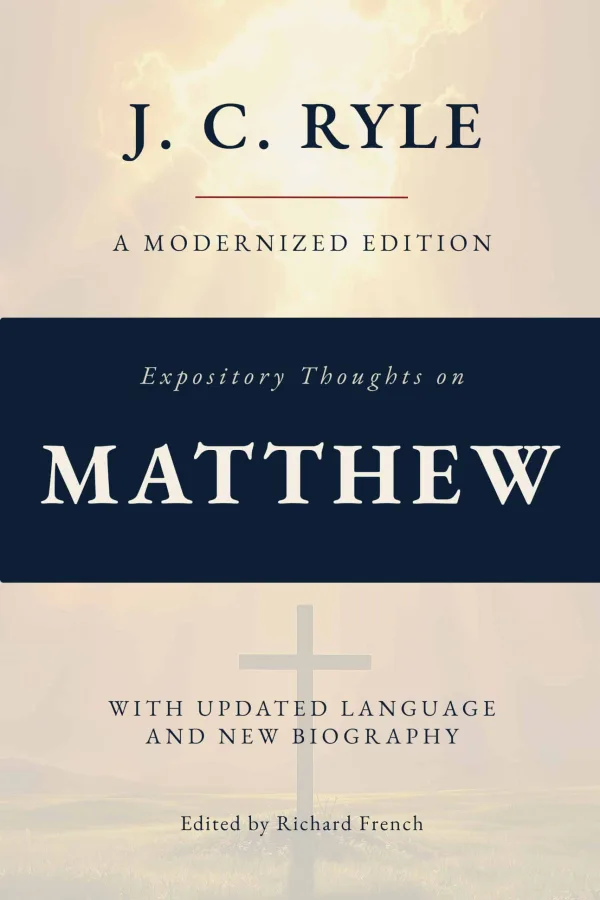
For readers wanting to trace how the Law and the Gospel connect across Matthew's narrative, J. C. Ryle's Expository Thoughts on the Gospels and the accompanying Matthew study workbook work through each passage in its immediate context.
What J. C. Ryle Says About Matthew 5:17-20
Ryle comments directly on this passage. After explaining that Jesus came to fulfill the predictions of the prophets, the ceremonial law, and the moral law, he warns against despising the Ten Commandments.
The coming of Christ did not alter the position of the Ten Commandments one hair's breadth. If anything, it exalted and raised their authority. ... The law of the Ten Commandments is God's eternal measure of right and wrong. By it is the knowledge of sin. By it the Spirit shows men their need of Christ, and drives them to Him. To it Christ refers His people as their rule and guide for holy living. ... It cannot save us. We cannot be justified by it. But never, never let us despise it.
J. C. Ryle, Expository Thoughts on Matthew, on Matthew 5:13-20 (modernized edition).
At the baptism, where Jesus said he would "fulfill all righteousness" (WEB Matthew 3:15), the Father declares that in his Son the holy law is honored rather than discarded. This is the same fulfillment Matthew 5:17 announces a few chapters later. The righteousness the Law demands comes to believers through Christ, which is why sinners can stand before God counted righteous.
Why This Passage Matters
Matthew 5:17-20 gives Christians confidence that the whole Old Testament is trustworthy and points to Jesus. The passage calls believers and teachers to wholehearted obedience rather than mere appearance. As Ryle writes, "The Christian who is content with a low standard of personal holiness has got much to learn" (J. C. Ryle, Expository Thoughts on Matthew, on Matthew 5:13-20). The Jesus who fulfills the Law also supplies the righteousness it requires, and holy living grows from that gift.
Conclusion
Jesus fulfilled the law by completing what the Law and the Prophets promised, pictured, and commanded. He upholds every stroke of Scripture, and he calls you to a righteousness that reaches the heart rather than stopping at outward conformity. If verse 20 feels searching, that's a sign you're reading it the way Jesus' first disciples did, and there's no shame in bringing honest questions to it. You can rest in Christ, who fulfilled all righteousness on your behalf, and pursue the heart obedience the antitheses describe with real joy. For more passage-by-passage study, continue through Sermon on the Mount Explained: A Verse-by-Verse Guide, and for a deeper look, see J. C. Ryle's Expository Thoughts on the Gospels: Matthew (modernized edition) and the accompanying Matthew study workbook.