Jesus first spoke the words "love your enemies" to people who lived under Roman occupation. Soldiers, tax collectors, and persecutors were daily realities for his first hearers, and Jesus had just warned them that they too would be reviled and persecuted for his sake (WEB Matthew 5:11-12). Against that backdrop, the command to love your enemies in Matthew 5:43-48 lands with full weight.
Many readers consider this passage the hardest command in the Gospels. It is the sixth and final "You have heard... but I tell you" contrast in the Sermon on the Mount. The command to love your enemies calls for active good will, carried out through blessing, doing good, and prayer, and modeled on the Father's own generosity toward the evil and the good alike.
Maybe you've wondered whether you can love someone who keeps hurting you. Faithful readers have wrestled with that question for centuries, and it's okay to find this teaching searching. Jesus' first disciples felt the same weight. This article walks through the saying Jesus quotes, the call to pray for persecutors, the Father's sun and rain, the summons to "be perfect," and the parallel passage in Luke 6:27-36. For a fuller look at how this passage fits the whole sermon, see Sermon on the Mount Explained: A Verse-by-Verse Guide.
Quick Answer: "Love your enemies" is Jesus' command in Matthew 5:43-48 to show active good will toward people who oppose and mistreat us. Disciples carry it out by blessing, doing good, and praying for persecutors. The command is grounded in God the Father, who sends sun and rain on the evil and the good, and it calls believers to a love that leaves no one out.
Definition: The command to love your enemies in the Gospels refers to Jesus' call for his followers to bless, do good to, and pray for those who hate and persecute them, reflecting the complete love of the Father.
Key Scripture: "But I tell you, love your enemies, bless those who curse you, do good to those who hate you, and pray for those who mistreat you and persecute you," (WEB Matthew 5:44)
Key Evidence: Matthew 5:44 names four actions (love, bless, do good, pray). Matthew 5:45 grounds them in the Father's sun and rain. Luke 23:34 and Acts 7:60 show Jesus and Stephen praying for their persecutors, and Luke 6:27-36 records the same command in a parallel account.
Context: This command is the climax of six antitheses, showing the righteousness that exceeds that of the scribes and Pharisees (WEB Matthew 5:20).
This passage serves as the capstone of Jesus' teaching on kingdom righteousness in Matthew 5. It grounds a seemingly impossible command in the character of God himself, so that obedience flows from likeness to the Father rather than sheer willpower. The implication is encouraging: you are asked to reflect a love you have already received. The sections below look at what the four verbs in Matthew 5:44 require, how the passage fits its context, what Jesus means by "perfect," and what Ryle draws out about the standard Christ sets for his followers.
Key Takeaways
- Four concrete verbs: Jesus' command takes shape in four actions: love, bless, do good, and pray (WEB Matthew 5:44).
- A saying outside Scripture: Leviticus 19:18 commands love of neighbor. The added line "hate your enemy" is a popular inference, not an Old Testament command.
- The Father's likeness: God's sun and rain on evil and good show the family resemblance disciples are called to bear.
- Beyond reciprocity: Love that returns only love matches the conduct of tax collectors, the group Jesus' first hearers least admired.
- Complete love: Teleios in Matthew 5:48 describes love that is whole and undivided, not flawless performance.
What Does Jesus Mean When He Says Love Your Enemies?
Jesus' command to love your enemies is carried out in four actions: love, bless, do good, and pray for those who mistreat and persecute us (WEB Matthew 5:44). The Greek word behind "love" here is agapaō, a love of the will rather than warm feeling. It names chosen good will toward another person, whatever we happen to feel in the moment. The verb translated "persecute," diōkō, shows that Jesus has real hostility in view, not mere annoyance.
Prayer comes first in practice. Praying for the person who wrongs us keeps contempt from taking root in the heart. Jesus prayed exactly this way from the cross: "Father, forgive them, for they don't know what they are doing." (WEB Luke 23:34). Stephen followed his Lord's example at his own death (WEB Acts 7:60).
Tax collectors set the measuring stick in Matthew 5:46-47. Jesus asks his followers to go further than that. His teaching builds on the passage just before it; see the discussion of turning the other cheek in Matthew 5:38-42.
The Father's Sun and Rain
Jesus grounds the command in God's own conduct toward the world (WEB Matthew 5:45).

- Common kindness: God gives sun and rain to the just and the unjust alike.
- Our place: That undeserved kindness includes every believer already.
Understanding Matthew 5:43-48 in Context
This passage closes the unit that begins at Matthew 5:17, where Jesus says he came to fulfill the Law and the Prophets. Matthew 5:20 then calls for righteousness exceeding that of the scribes and Pharisees. Jesus' words "But I tell you" claim the authority of the one who fulfills the Law, an authority his first hearers found striking.
The "Father" language of Matthew 5:45 and 5:48 leads into Matthew 6 and the Lord's Prayer. Love for enemies belongs to the life of the Father's children, a theme taken up in our discussion of Matthew 6:1-15.
It helps to read 5:48 alongside the earlier statement about fulfilling the Law. For more, see our passage on Matthew 5:17-20.
Is "Hate Your Enemy" in the Old Testament?
This question deserves care. Jesus quotes a saying current in his day, not a single verse.
- First half from Scripture: Leviticus 19:18 commands, "you shall love your neighbor as yourself." (WEB Leviticus 19:18)
- Second half an inference: No Old Testament text commands hatred of enemies. The added line reflects a narrowed popular reading of the Law.
- The Law's own kindness: Exodus 23:4 and Proverbs 25:21 require good done to enemies.
The Parallel in Luke 6:27-36
Luke records the same command in his Sermon on the Plain (WEB Luke 6:27-28).
- Shared core: Both accounts include love, doing good, blessing, and prayer for those who mistreat us.
- Distinct emphasis: Luke adds lending and speaks of "children of the Most High," closing with "be merciful."
- One truth: Matthew's "perfect" and Luke's "merciful" describe the same complete love from two angles.
Be Perfect: How to Love Your Enemies Today
To love your enemies is to reflect the completeness of the Father's love: "Therefore you shall be perfect, just as your Father in heaven is perfect." (WEB Matthew 5:48). The word teleios means complete or whole, having reached its goal, and it echoes Deuteronomy 18:13. In context it describes love that excludes no category of person, not flawless performance in every area of life.
Some read it as an attainable goal of maturity; others see an ideal that drives us to depend on Christ. Many hold both readings together without conflict.
A few practical steps can help. Pray by name for a person who has wronged you, speak a blessing where cursing would come naturally, and do concrete good where it is wise and safe to do so. Love for an enemy fits with seeking safety, justice, and healthy boundaries, and it leaves room to name wrongs honestly. The passage speaks to personal conduct between individuals. Questions of war, courts, or government policy are separate matters this text does not directly address.
Christ loved his enemies at the cross, and believers were once among them. In Matthew 5:48, "perfect" describes a whole and undivided love that mirrors the Father's kindness to all. Obedience here draws on grace already received, not effort offered first.
What J. C. Ryle Says About the Christian Standard of Love
We ought to put away all malice. We ought to return good for evil, and blessing for cursing. ... A standard of conduct like this may seem, at first sight, extravagantly high. But we must never content ourselves with aiming at one lower.
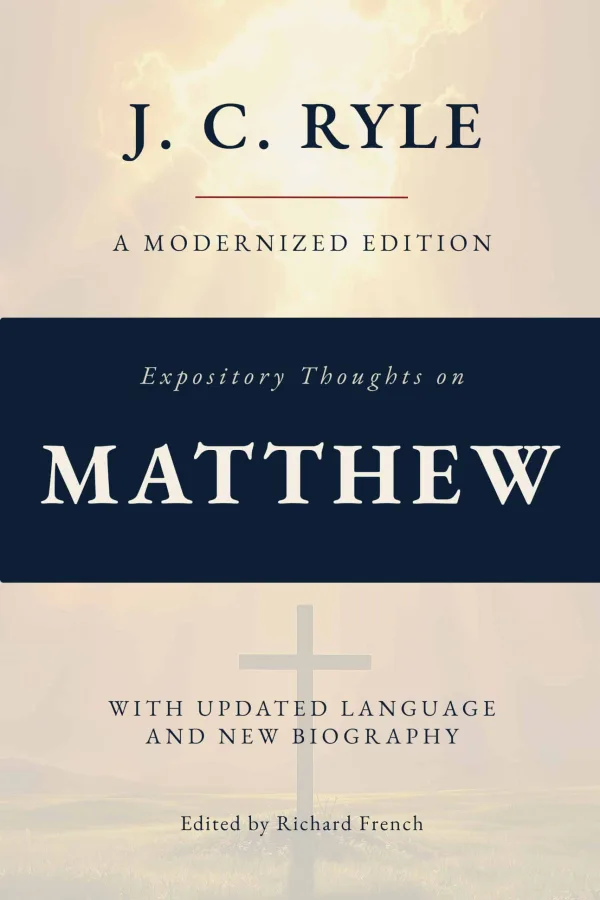
J. C. Ryle, Expository Thoughts on Matthew, on Matthew 5:38-48 (modernized edition).
Ryle writes these words on Matthew 5:38-48, the verses this article explores together with the sayings just before them, and he refuses to lower the bar. He grants that the standard looks extravagantly high, then points to the two arguments Jesus himself gives: a son should be like his father, and even those with no religion can love the people who love them. For Ryle, a Christian ought to be moved by higher principles than these. For readers wanting to trace this theme across the whole Gospel, J. C. Ryle's Expository Thoughts on the Gospels examines each passage in its immediate context.
Why This Passage Matters
This command reveals the heart of the Father and the pattern of the Son, who prayed for those who crucified him. Every believer has someone placed outside the circle of easy affection. Jesus calls us to draw that person back in through prayer and concrete good. God's kindness to the undeserving reached us first, and that same kindness supplies the strength to show it to others.
Conclusion
To love your enemies is to love, bless, do good, and pray for those who oppose us, reflecting the Father who gives sun and rain to all. The six antitheses of Matthew 5 reach their summit here, in a righteousness that excludes no one. You don't have to master it in a day. Begin this week with a prayer for one person who has wronged you, and trust that the Father sees every wrong and that Christ has already walked this road before you. For a deeper passage-by-passage exploration, see Sermon on the Mount Explained: A Verse-by-Verse Guide, along with J. C. Ryle's Expository Thoughts on the Gospels (modernized edition) and the Gospel study workbooks.